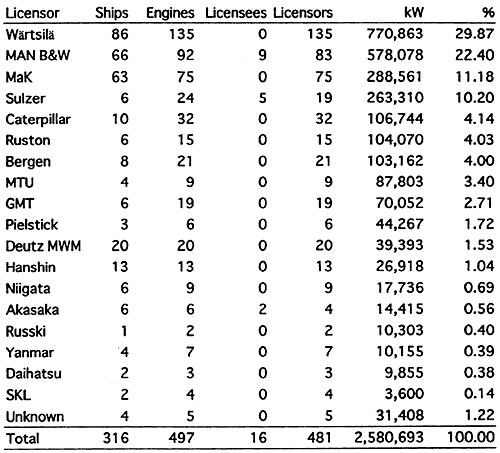
In 1997 it produced 553,686kW compared with 770, 863kW in 1998. MAN B&W, MaK, Sulzer and Caterpillar also all saw increases although, in percentage terms MaK witnessed a slight drop from 12.57% to 11.18%. Formerly among the companies at the fore-front of medium-speed deliveries, Pielstick showed a sharp drop from 195,736 to 44,267kW.

2.2 Domestic Trend by Statistics of Nippon Kaiji Kyokai
According to statistics of Nippon Kaiji Kyokai, 281 newly built ships were registered with NK class in 1999, showing the notable decrease by about 22.6% compared with 363 ships in 1998, as shown in Table 2.2-1.
Among the total newly built ships, 278 are equipped with diesel engines, and the total output is 2,330,851kW, showing decrease by 10% compared with 2,590,819kW in 1998 as shown in Table 2.2-2~3. In spite of remarkable decrease the number of ships which installed 4-stroke engines, like Fig.2.2-1, the total output number of diesel engines is not so decrease from last year, due to supply of higher output 4-stroke engines, like Fig.2.2-3. And it seems that the monopolization of large engines reaches a stage, like Fig.2.2-2.
2.3 Studies at Ship Research Institute
Since the emission control from ships by IMO (the International Maritime Organization) will be scheduled to come into force on after January 1,2000, and the substances to cause the global warming effect are regarded as a problem. Power and energy engineering division in Ship Research Institute has been challenging the researches concerning reduction of harmful exhaust gas to be emitted from marine engines.