Injection nozzle with 145°spray angle, five holes and 0.25mm hole-diameter was used, considering fuel consumption and smoke density. The standard injection timing θi is 0°ATDC. θi was changed by every 2.5°crank angle from -5°ATDC to 5°ATDC. Engine performance and emission data were obtained under stable operating conditions at engine speed of 1800rpm and coolant temperature of 800℃.
The fuels were designed based on JIS #2 diesel fuel (density of 834.7kg/m3, lower calorific value of 45.77MJ/kg) with different cetane number CN and aromatic content AR as fuel properties. AR38CN55 and AR38CN43 fuels have 38wt% aromatic content (27.6% single ring and 11.1% double rings) with cetane number CN55 and CN43 respectively. AROCN56 and AROCN43 fuels are without aromatics with cetane number CN56 and CN43 respectively. Cetane number was controlled by changing the mixture ratio of n-paraffin and i-paraffin. Cetane number was measured by CFR engine. These four fuels have the 90% distillation temperature T90 of 307±30℃ and sulfur content of less than 1 massppm. The effect of aromatics was investigated with cetane number CN56 and CN43 for both AROwt% and AR38wt%. The effect of cetane number was examined by using CN43 and CN56 fuels with aromatic content of AROwt%.
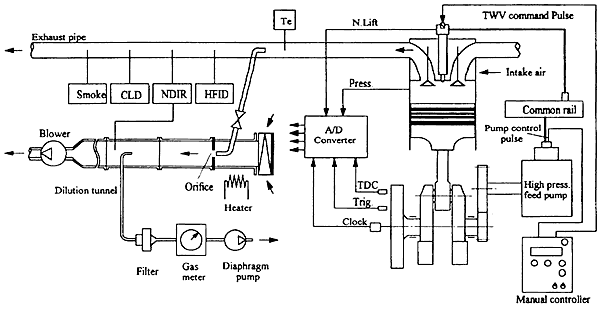
Figure 2 shows the schematic diagram of the experimental apparatus. A mini-dilution tunnel with 70mm inner diameter and 680mm in length(14) was employed for sampling particulate emissions. A part of exhaust gas was introduced to the mini-tunnel at the l.6m downstream from exhaust valve and diluted at dilution ratio of 10. Particulate concentrations were determined by measuring filter weight before and after sampling. The soluble organic fraction (SOF) was extracted from the particulate sampling filter by Soxhlet extraction method using dichioromethane as solvent.
3. Experimental results and consideration
3.1 Effect of cetane number
First, in order to investigate the effect of cetane number, emission characteristics for AR0CN56 are compared with those for AROCN43 applying different injection pressures of 50MPa and 100MPa on the condition of injection timing θi0°ATDC. Figure 3 shows the emission characteristics such as energy consumption rate BSEC, smoke density S, THC and NO concentrations, particulate PART, SOLID and soluble organic fraction SOF against mean effective pressure Pe. Fuel consumption rate is defined by energy consumption rate BSEC because every fuel has each lower caloritic value. At high load for every injection pressure, the low cetane number fuel shows lower smoke and particulate concentrations than the high cetane number fuel.