Technical Papers
Effects of Fuel Properties on Combustion and Emissions of a Direct-Injection Diesel Engine*
By Changlin Yang**, Yoshiyuki Kidoguchi**, Ryoji Kato, Kei Miwa**
In this study, experiments were carried out to investigate the effects of fuel properties such as cetane num-ber, aromatic content on NO, THO, smoke and particulate emissions of a DI diesel engine. Cetane number and aromatic content of the fuels were varied independently to separate their effects on emissions. The results showed that for the fuels with the same aromatic content, reducing cetane number resulted in the decrease of particulate emission and the increase of NO emission. As cetane number was kept constant, changing the aromatic content had little effect on combustion characteristics. However, increasing aromatic content resulted in higher particulate and NO emissions. At retarded injection timing, for the low cetane number fuels, THC increased dramatically at low load due to the overleaning caused by long ignition delay. In particular, for the low cetane number fuel with aromatic content, not only THC but also SOF increased at low load. As the injection pressure was raised, NO increased and particulate decreased for all fuels tested, and also par-ticulate emission became less sensitive to fuel properties.
1. Introduction
Direct-injection diesel engines have been widely used because of their inherent high thermal efficiency and low C02 emission. However, reduction of NOx and particulates emitted from direct-injection diesel engines is of urgent necessity because emission regulations have become stringent from a standpoint of preserving the environment.
In order to reduce exhaust emissions, improvement of combustion, such as high pressure injection, EGR, pilot injection, modification of combustion chamber and two stage combustion, have been attempted (1)~(6). In addition to their approaches, effect of fuel properties such as cetane number, aromatic content, distillation temperature, density and viscosity on combustion characteristics and emissions have investigated (7)~(13). However, it is difficult to separate the effects of various fuel properties on emissions because they affect each other.
In this study, cetane number and aromatic content were varied independently as fuel properties with keeping distillation temperature and sulfur content constant. The engine test was carried out at steady operation with various load, injection timing and injection pressure. In order to clarify the effects of fuel properties, combustion characteristics such as heat release rate, ignition delay and combustion duration, and emission characteristics such as NOx, particulate and total hydrocarbon (THC) were investigated.
2. Experimental setup
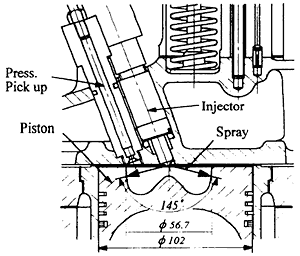
The test engine is a four-stroke single cylinder naturally aspirated direct-injection diesel engine (Bore 102mm, stroke 105mm, compression ratio 17.0 and swirl ratio 2.2). Combustion chamber geometry is standard deep-bowl type toroidal chamber as shown in Fig.1. The electrically control common rail injection system (Denso ECD-U2) is mounted on the test engine. The injection pressure was raised from 50MPa to 100MPa.