7.1.2 Sandwich construction
In general the outer and inner skins shall be similar in lay-up and in strength and elastic properties, each with similar tensile and compressive strengths and moduli. Special consideration has to be given where this is not the case.
In general the sandwich area of the hull forward of 0.5 ・ Lwl shall be supported by one longitudinal stringer or an alternative arrangement.
7.1.2.1 Section moduli
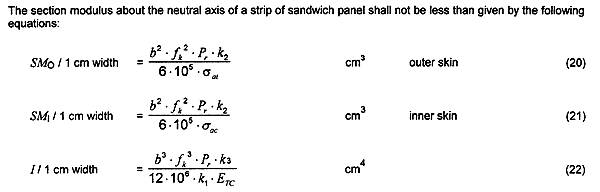
where
b is the shorter edge of plate panel, in millimetres;
l is the longer edge of plate panel, in millimetres;
Pr is the applicable design pressure, kN/m2.
k1 see 6.1, table 5;
k2 is the coefficient, panel aspect ratio, for bending strength (see 7.1 .1 , table 6);
k3 is the coefficient, panel aspect ratio, for bending stiffness (see 7.1 .1 , Table 6):
EF is the flexural modulus, FRP single skin laminate;
σat is the design stress, outer skin, for FRP (see clause 6). N/mm2.
σac is the design stress, for FRP (see clause 6), N/mm2.
ETC is the mean of tensile and compressive moduli for inner and outer skins of sandwich, N/mm2
fk correction factor for curvature (see table 7)
7.1.2.2 Core shear strength
where
do is the overall thickness of sandwich excluding gel coat, in millimetres;
dc is the thickness of core, in millimetres;
ν is the coefficient varying with plate panel aspect ratio. Where the elastic properties of the skins are different in the principal axes, v is to be taken not less than 0,5;
P is the design pressure, kN/m2, as given in Clause 5, except that Ad shall be taken not less than b2 and kar not less than 0,4;
τa is the design shear stress (see 6.1.3), N/mm2 ;
b is the smaller side of the panel, in millimetres.



