At the moment four such formulas are discussed in the international standardisation. These are (also table 1) :
1. IMO standard [4], the physiological basics are unknown (to me),
2. ISO standard [5], that can be derived from the difference threshold,
3. Functional connection that's based on a formula from Webber [6]. These formula can be derived from the difference threshold also and
4. Determination by distance factors, that are mainly used for signs. These distance factors have only been given in graphical form. They are based on examinations of the visual acuity [7,8].
Table 1 : Formulas to calculate the width of the guidance line in dependence from the luminance of the luminescent material.
L : Luminance after 60 minutes discharge
d : Width of the guidance line
c : Constants
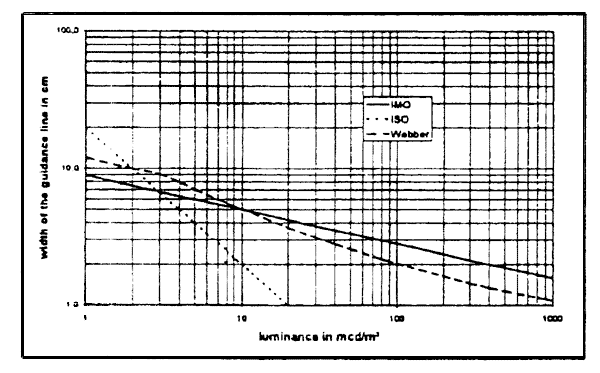
Picture 3 : Width of a guidance line in dependence of the luminance of a photoluminescent product, calculated for three different formulas.
Note, that the "ISO-Formula" sets a minimum width of 2 cm.
The picture shows clearly the differences between the three formulas. The highest dependence can be seen at the "ISO-formula". It is to note, that here the minimum width is 2 cm. These width is already reached at 10 mcd/m2.
The "IMO-formula" results in smaller line widths as both other formulas for low luminance's. In the area between 10 and 100 mcd/m2 that is interested if we increase the luminance of photoluminescent material, there are only small differences in the resulting luminance's.
The "Webber-formula" shows a characteristic blip at approximately 3 mcd/m2. This blip is caused by physiologic reasons. The dependence of the line width from the luminance is smaller as that of the "ISO-formula" but stronger as that of the "IMO-formula"