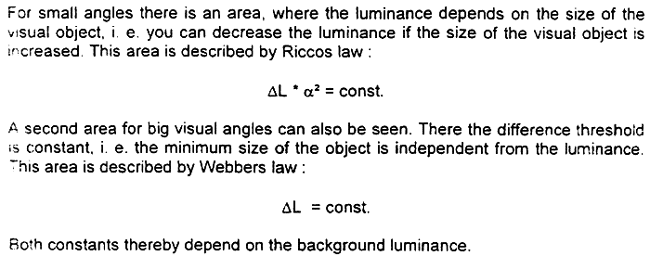
The transition between the two areas is defined by the so called Riccos critical angle. This critical angle also depends on the background luminance. It's approximately 1゜ for dark surrounding (background luminance 10-5 cd/m2)[3]. For luminance's and line widths we find at photoluminescent materials, the visual angel is smaller than the critical angle. So a reduction of the width of the guidance line with increasing luminance is possible.
A second thing is also important, the recognition distance. This means the distance that a visual object can be detected from. It is to distinguish from the identification distance, where also the meaning of the visual object is detected. If only lines are considered, only the recognition distance is relevant.
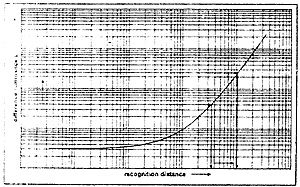
The recognition distance is calculated by the visual angle and the true size of the visual object (i.e. the width of the line). When the luminance is increased, also the recognition distance increases, because the necessary visual angle decreases (Picture 2). If a constant recognition distance is demanded, the width of the guidance line can be reduced.
Picture 2 : Difference luminance in dependence of the recognition distance. The recognition distance l is calculated from the visual angle α, by l = d / (2* tan α), where d is the size of the visual object. The difference luminance is equivalent to the difference threshold when a dark surrounding is assumed.
So we can summarise, that
1. by increasing the luminance, we can decrease the width of the guidance line and
2. thereby no loss in recognition must occur.
Comparison of current proposals
The problem is now, to use these fundamentals in practice. I. e. a formula that connects in an easy way the width of the guidance line with the luminance is needed.