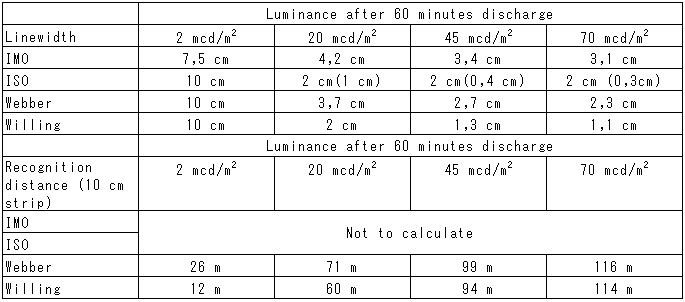
To compare this with the "Willing-formula" table two shows the width for four characteristic luminance values. 2 mcd/m2 after 60 minutes discharge is the typical luminance for products based on ZnS. It is also the value that is set as minimum for practical use in many standards. 20 mcd/m2 and 45 mcd/m2 after 60 minutes discharge are luminance's (according to DIN 67510-1 [1]) for common products based on strontium aluminate. At the end 70 mcd/m2 (also according to DIN 67510-1) is today the maximum luminance that photluminescent products reach after 60 minutes discharge.
The values of table 2 show, what was already commented about the graphs. Included in addition is the width of the guidance line according to Willing. These values are between the values according to the "Webber-" and "ISO-formula".
Table 2 : Width of the guidance line and recognition distance of an 10 cm width guidance line for four typical luminance's.
More interesting here is a comparison between the recognition distances. Webber and Willing allow to this to be calculated. It can be seen, that the values correspond well for higher luminance's. From my point of view, the differences for smaller luminance's arise from the different sources of origins of the formulas. The visual acuity, the fundamental for the "Willing-formula", requires the identification of the visual object, whereas the difference threshold, the fundamental for the "Webber-formula" only requires the recognition of the visual object.
Altogether, no conclusive recommendation or support for a particular formula is possible because of :
1. the great differences between the four formulas and
2. the problem that the derivation of the formulas is not always understandable for me. But it is not possible to explain it some more in this frame.
But based on the formulas, own calculations and practical experiences, it can be said, that the line width are practical between 4 cm at 20 mcd/m2 and approximately 2 cm at 70 mcd/m2.
Practical use
Now, what do this considerations mean for the practical use of long afterglowing materials ?