Luminance and width of a guidance line
Uwe Adomeit
June 1999
Introduction
In the course of the introducing of new photoluminescence materials and the associated higher luminance's, it is questioned, whether the width of the guidance lines of 10 cm can be decreased. That's not only of theoretical interest but also from practical use, because user always demand smaller guidance lines, especially when the use of photoluminescence material in representative areas is planned.
So the question is, if respectively how the width of a guidance line can be altered in dependence of the luminance of the photoluminescence material.
For clarification of this question it's helpful to take a look at the basic visual functions.
Fundamentals
Important for the connection between luminance and the size of an visual object is the difference threshold of the human eye. This function describes the ability of the eye to discern brightness differences in other words it describes, when an object can be seen against its background.
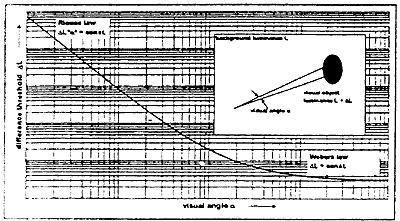
Picture 1 : Basic relationship of the difference threshold in dependence of the visual angle.
Insert picture : Test situation for measurement of the difference threshold.
The insert picture in picture one shows the testing situation for measuring the difference threshold. In this situation a test person has to adjust the brightness (luminance) of the visual object at given background luminance and size of the visual object, so that it's just seen. The result of such an psychophysical examination is presented in picture one.
You can see the luminance, that a visual object must have against its background to be seen in dependence of the size of the visual object. The size of the visual object is described by the visual angle, because it is independence from the real size. For example a circle that is seen under a visual angle of 1゜ has an diameter of 17 cm seen at 10 m distance and 17 cm at 1 m distance.