(2) Measurement of cell internal resistance
For the measurement of cell internal impedance, a minute AC voltage of 10 mVrms from the frequency analyzer (FRA) was input into the PGS stated above, and added to the test cell in the shape that it was superimposed on the DC voltage of the PGS. The values of the voltage/current (impedance) thus obtained were plotted on the complex coordinate to examine a difference between the test cells.
(3) Load change follow-up capability
Under the conditions that the voltage and current were stabilized at constants, the behavior of the voltage values (or current values) when the current values (or voltage values) were varied stepwisely was measured and, from its transient response curve, the follow-up capability to the load change of the cell was studied. The measurements of cell internal resistance and load change characteristic were performed at the working temperature of approx. 1000℃.
3.3 Results and Consideration
3.3.1 Cell sectional structure
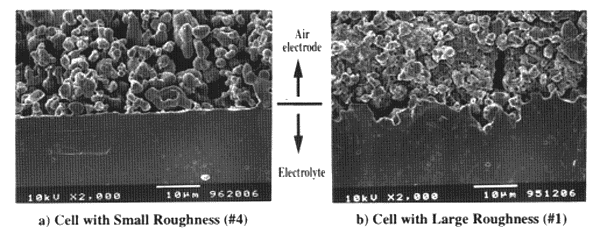
Figures 4a) and 4b) show the sectional SEM photos of a cell with relatively small roughness (#4: Ra = 0.25) and one with relatively large roughness (#1: Ra = 1.38), respectively. In the #4 cell SEM photo, the boundary between the electrolyte and air electrode is observed to be linear, whereas in the #1 cell SEM photo, it is observed to be structured complicatedly. This fact was confirmed also in the measurement of material component distribution by the EPMA. In addition, the same trend was observed in the fuel electrode. It is estimated that, by the surface finishing stated in the previous chapter, the interface is stuck three-dimensionally, and the actual contact area becomes larger than the apparent contact area. The effects of the surface roughness of the electrolyte on the power generation characteristics cell are described below.
3.3.2 Power generating performance
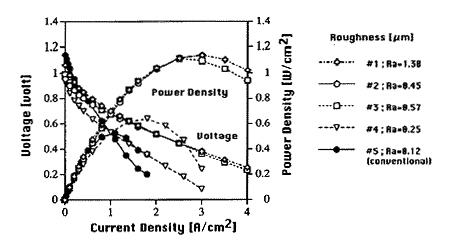
Figure 5 shows the V-I and W-l characteristics of each cell. The unfinished cell #5 is thinner in the thickness of electrolyte than the other cells and, accordingly, the internal impedance should smaller and, therefore, a rather high voltage value is expected to be measured.
Fig. 4 Comparison of Cross Sections of Cell by SEM
Fig. 5 Power Generation Characteristics of Each Cell