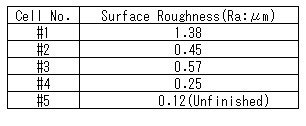
Also the unfinished electrolytes used for comparison are shown in Tables 1 and 2. Their thickness is 100μm.
3. Effects of Roughness of Electrolyte Surface Using Hydrogen as fuel
3.1 Experimental Apparatus
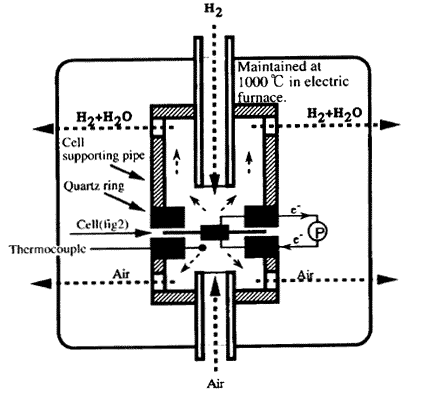
Figure 3 shows the experimental apparatus and the installation of the test cells. A platinum net for collecting electron was covered on both electrodes of the cell, two pairs (4 terminals) of platinum wires were connected to the platinum net, and the wires were extracted as leads. Among these wires, a set of two wires (fuel electrode and air electrode each) were used as leads for voltage measurement and a remaining set of two ones were used as leads for current extraction. In addition, the cell was installed on the cell supporting pipe by sandwiching between two quartz rings so that the electrode surfaces covered with the platinum net were exposed.
As shown in the figure, fuel is first fed from the upper side and returns upward through the annular section of the double tube, and then exhausted from the exhaust port. On the other hand, air is first fed from the lower side and then exhausted in the peripheral directions. in addition, a pair of R type thermocouples (0.3 mm in diameter) were arranged in a position apart slightly from the surface of the air electrode, and cell temperature was measured. A total set of cell supporting pipe, leads, and thermocouples thus assembled were set in the electric furnace.
Fig. 3 Experimental Apparatus and Cell Installation
3.2 Experiment and Measurement
In the experiment, the output of the electric furnace was controlled so that the temperature of the cell was kept at a constant. As fuel, a mixture of hydrogen of 200 cc/min and nitrogen of 200 cc/min was fed from each cylinder through the flowmeter. The gas after reaction was released to the outside of the furnace by a diaphragm pump. Air as oxidizer was fed at a flow of 500 cc/min from an oilless small compressor.
The measurement was performed with respect to power generating performance, cell internal resistance, and load change characteristics in the manners shown below.
(1) Measurement of power generating performance
For the measurement, four leads for the voltage and current from the test cell were connected to the potentio galvanostat (PGS). The value of cell voltage, V, at each current density, I, was measured mainly by the constant current method (a method in which, while a current was maintained at a constant, a variation in voltage is observed). From V and I thus obtained, an electric power density, W, was obtained by calculation in order to obtain the V-I and W-I characteristics. In the experiment, the power generating performance at the working temperature of 1000℃ was obtained for each of five test cells, of which interfacial roughnesses are different from each other(one is not finished).
They are shown in Table 2. Also, in order to study the optimum working temperature of the cells the power generation characteristics of one of them were examined while the working temperature was varied. In general, the internal resistance of a cell is known to increase as the working temperature decreases. With the thermal resistance of the power generator components taken into account, the upper limit of the working temperature is considered to be approx. 1000℃. In this experiment, the power generation characteristics at three temperatures of 800, 900,and 1000℃ were measured and compared.