In addition, using the same cell as used for hydrogen fuel, the experiments on the reforming reaction and power generation characteristics in which natural gas were used as fuel were performed to examine its applicability. The results thus obtained are reported as follows.
2. New Fabricating Method of Cells
2.1 Surface Finish of Electrolyte Plate
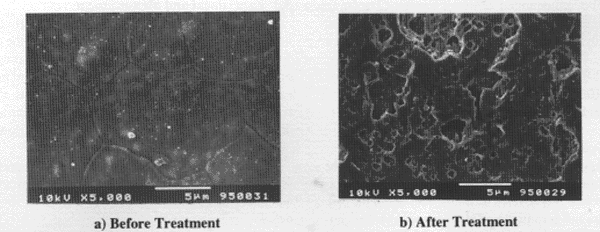
Using a commercial electrolyte plate in which YSZ (Yittoria Stabilized Zylconia, ZrO28mol%Y203) was used as electrolyte material, surface finish was performed by the chemical treatment with acid (smooth surface was toughened by partial erosion). Figures la and lb show the SEM (Scanning Electron Microscope) photos of the electrolyte surface before and after the treatment. From the photos, it can be observed that the smooth surface is obviously changed to a rough surface.
Also, using the EPMA (Electron Probe Micro-Analyzer) and X-ray diffraction, the distribution and chemical change of the components on the electrolyte surface before and after the surface finish were studied. As a result, a slight change in spectrum component was found, but basically their effects on the cell performance are considered small.
2.2 Firing of Electrode
As electrode material, the mixture obtained by mixing NiO powder with YSZ powder at the ratio of 6 to 4 was used for the fuel electrode, and La0.85Sr0.15MnO3 powder was used for the air electrode. Each electrode material was formed in a slurry by mixing it with ethanol at a weight ratio of approx. 1 to I beforehand, coated on the electrolyte surface described in the previous section, and fired in the electric furnace. In firing each electrode, the rising and lowering rates of the temperature in the electric furnace were maintained at 5℃/min or less, the temperature was held at 1450℃ at the fuel electrode and at 1150℃ at the air electrode, and the holding time was 12 hours at both temperatures.
2.3 Test Cells
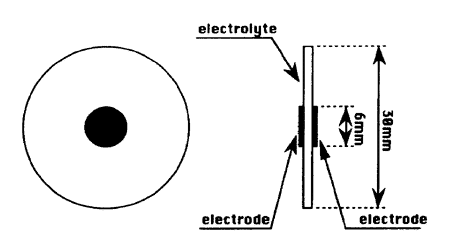
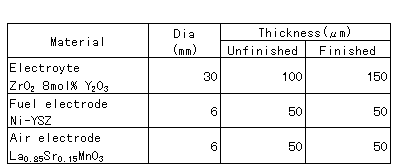
The components, dimensions, and configuration of electrolyte and each electrode used in the experiment are shown in Figs. I and 2, respectively. The surface roughness (arithmetic average Ra(μm)) of the electrolyte of each cell is shown in Table 2. The thickness of the electrolyte is 150μm and the diameter of it is 30 mm and, to form a cell, each electrode is attacked at the center of both surfaces of the electrolyte in the procedure above mentioned so that it becomes 50μm in thickness and diameter in 6 mm.
Fig. 2 Configuration of Test Cell