In any methods for data analysis, the MWF have some weak points. In particular, there are two major sources that possibly cause artificial results obtained by the MWF; One is the end effects of the record and the other is the limitation of the temporal resolution. The end effects generally weaken the filtered amplitudes near the beginning and end of a data record. In order to reduce the end effects, before making the wavelet transform, we extend the time series by 30% at the beginning and end, using an auto-regressive model based on a Maximum Entropy Method of order 30. The MEM extension, however, cannot totally remove the end effects. Thus, when the maximal amplitudes are found in the middle of the record, we need to carefully address whether the maximum is a realistic feature or an artifact.
Low temporal-resolution associated with the sharp filter-gain structure of the MV/F can make spatial structure changes obtained by the MWF smoother than in reality. Thus, when the smooth spatial structure change is found in the results by the MWF, it is recommended to check the results of a conventional band-pass filter that has a wider pass-band and hence higher temporal resolution, sacrificing the resolution in frequency. In the present paper, we employ a band-pass filter with the half-power points at 10- and 30-year periods.
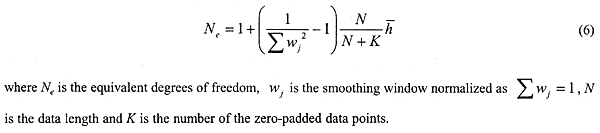
MWF data are complex valued data, and hence the MWF can capture a phase-lag relation as complex EOFs. In order to know the reliability of the apparent phase-lag relation found in the MWF, we will calculate phase spectra and squared coherency between two SLP time series as follows. The SLP data are tapered by a cosine function by the 10% of the beginning and end from 1899 to 2000; The data are zero-padded to 256 data points for a better frequency resolution not to miss an important coherency peak, and the raw cross spectra are smoothed by a 13-points triangle smoothing window. The equivalent degrees of freedom, Ne, is estimated as.