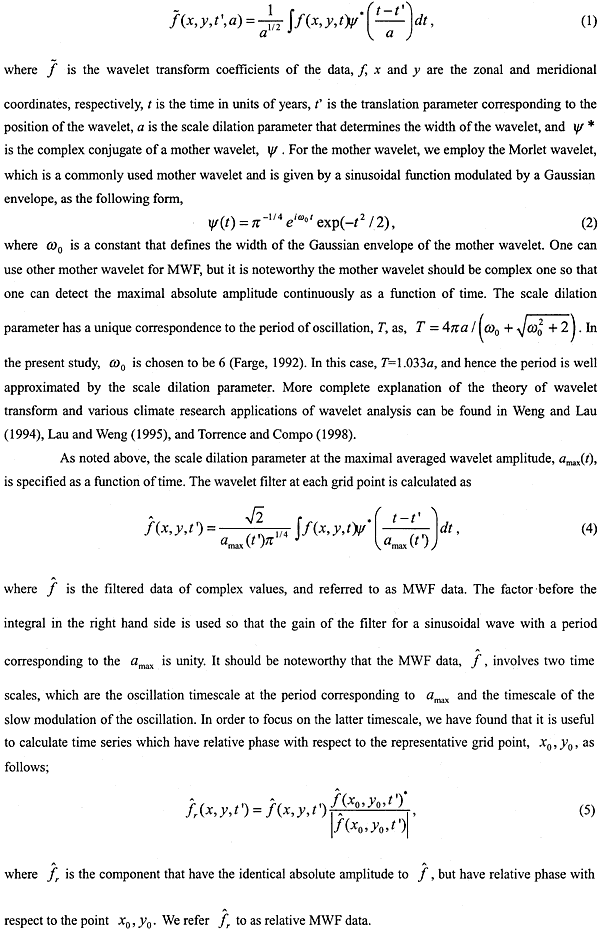
There are two ways to construct the area-averaged wavelet amplitudes in the detection stage. One is to calculate the area-averaged time series within a specific region first, and then the wavelet transform is applied to the averaged univariate time series. The other is to perform the wavelet transform at each of the grid points, and then the absolute value of the wavelet coefficients are averaged over the area. When the variability has significant phase lag or two or more signs over the interested area, the latter method would have an advantage of capturing the total energy of the phenomenon. On the other hand, the former method requires only smaller computation amounts, and in many cases area-averaged time series and its wavelet coefficients themselves may be of interest. Thus, we suggest calculating the area-averaged time series first, unless significant energy of the phenomenon cannot be captured by this simple method. For the present study, there are no significant differences between two procedures, and we described in the next section for the results obtained with the MWF using the latter procedure.
Wavelet transform coefficients defined as follows;