References:
1) "Monthly Report informative data about oil", JPI, 45-3 (2000)
2) "Monthly Report, Energy, Production, Supply", 1999. No.1-12
3) "Pollutants of exhaust gas from ships and Reduction Technique Seminar handout produced" by JICEF p.1 1999.7.21
4) "The Technical Report of Marine engineering Society" 35-1 (1999)
5) Information of Japan Internal Combution Engine Federation January No.77
6) Nakajima et all, "Paper of Marine Engineering Technical Symposium", p.121-124 1999
7) Nakajima et all, "Paper of Japan Machine Society Technical Symposium about traffic and Transration", p.259
8) Tsukamoto et all, "Paper of Marine Engineering Technical Symposium", p.129-132
9) Nishida et all, "The technical Report of Marine engineering Society" 35-3 (1999)
10) Azetsu et all, "Preprints of 62th annual Technical Symposium
11) BP Marine, AlfaLaval, International Bunker Conference the 20th. IBC. 20th-22nd October, 1999 in Osla
12) Petrotech vol.22. No.4
13) Petrotech vol.22. No.11
[Yasuyuki KOMATSU]
9.2 Lubricating Oils
9.2.1 Current Situation and Future Trends in Marine Engine Lubricants
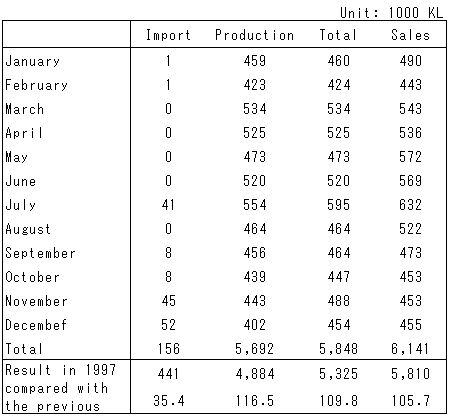
Table 9.3 shows the trends in domestic sales of engine oil for marine use (Statistics No.51 by MITI) from 1995 to 1999. After 1996, an increase of over 100%, was observed each year, compared with the previous year. In 1999, however the sales decreased by 99.7% compared with to the previous year. When globally viewed, the manufacture (total output) of diesel engines has increased over these years, in particular for low-speed diesel engines, where an increase of ca. 10% was observed. The decrease in domestic sales is believed to be attributable to the influence of the exchange and ongoing economic depression in Japan.
The environment in which oil makers and additive makers, who are the suppliers of lubricating oil, operate in is becoming more and more stringent, and mergers and collaboration of companies is rapidly proceeded, not only domestically but also internationally. It seems that the integration of blending technology and lubricating oil processing will further advance in the future. The direction of the research and development for the lubricating oils in the future will be influenced by these trends. On the other hand, it will be desirable for engine manufacturers and ship owners, as users of the lubricating oil, to control the type, of oil required.
Requests from engine manufacturers and ship owners tended to focus on requirement for an increase in the performance of the lubricating oil to satisfy the higher performance of the engines, and reduction of the running cost by reducing the oil consumption rate.
9.2.2 Lubricating Oils for Crosshead Engines
A case has been reported recently1) that hard deposits are generated in the piston top land and the back surface of the piston ring in engines of large bore size, and as a result, scuffing is generated in the cylinder liners. These phenomena have not been reported with engines of small to medium bore size. It is hypothesised that these problems are attributable to the lubricating oil, as the pressure and the temperature in the combustion chamber has increased due to the higher output of modern engines, hence the thermal load of the lubricating oil has increased, and conventional cylinder oils can no longer cope with these circumstances. The continual improvement by hardware by engine manufacturers is essential, hence necessitating an improvement in the performance of the lubricating oil in the future.