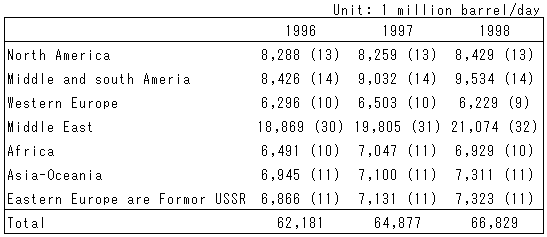
Regarding the sale by the kind of oil, the sale of gasoline and kerosene was increased (by 3%), while the sale of gas oil and heavy Fuel was leveled off.
It is also considered in future that the oil market is greatly affected by 1] the fluctuation in the price of crude oil accompanied by the trend of OPEC, and 2] the economic recovery in Japan. In March, 1999, the report was submitted on "the basic policy on the countermeasures for the global warming effect" by the Central Council for Environmental Control, and the report includes the energy-saving countermeasures and the positive promotion of the development and introduction of the new energy such as fuel cell and biomass energy, and it is thus necessary to pay attention to the changes in the future energy structure.
The import of heavy oil was increased by about 1.9 billion kl, and the export was decreased by 2.02 million kl. Table 9.2 shows the result of demands and supplies of the domestic bond heavy oil. Production and sale were decreased, and the ratio of the import to the production is on the increasing trend compared with that of the previous year.
9.1.2 Marine Fuel Oils
As for the trend of regulation of the exhaust gas from ships, the "Regulation on Air Pollution Prevention from Ships" was adopted as the Annex VI of MARPOL in IMO (International Maritime Organization) in September, 1999, but its ratification works have not been completed yet. There is a supposition3) among shipping companies in Europe that the present Convention will not be ratified but operated as a local convention, and attention should be paid to the response of related countries including Europe and America.
In Japan, the "Consideration and examination of the method for reducing the air pollutant substances discharged from ships" under the commission of the Environment Agency, has been implemented continuous to that of the previous year, showing very interesting especially for the present situation of the discharge of particulate matter (PM).
The third amendment of ISO Standard on fuel oil (IS0-8217) has been examined, its Working Draft was completed in last December. The following amendments were adopted in the standards on fuel oil; 1] Amendment of the standard water content from 1% to 0.5%, 2] Amendment of the standard on ash content from 0.2% to 0.15% or 0.10%, 3] Amendment of the standard sulfur content from 5.0% to 4.5% in accordance with the regulation of IMO, etc. In addition, the mixing of used lubricating oil in fuel oil, and the sample point are also under examination4).
In CIMAC, discussions have been continuously made on of the amendments dealing with the problems of mixing used Lubricant oil, the standard value of fuel oil at the engine inlet, and the CIMAC standard of fuel oil. In particular, not discussion about mixing used Lubricant oil in Fuel oil were made domestically and internationally on the acceptance/rejection of the standardization and the method for detecting used lubricant in the fuel (the method of measurement), and this topic should be paid attention to the trend in future. Regarding the standard of fuel oil, a new proposal5) has been submitted that the grade of low-sulfur fuel in compliance with the IMO regulation on exhaust gas be imposed on distilled oil and residues.
References published in 1999 include many focused on the environmental issues, and references on the measuring method of the exhaust gas are also published. In last September, the method for measuring dioxin in exhaust gas was specified in JIS, and investigation of a new measurement method for particulate matter from marine diesel engine6) is also introduced. Two interesting references about the influence of the fuel and exhaust gas was published, one's the relationship7) the kind of fuel oil and the exhaust concentration of the volatile organic compounds such as methane, ethane and benzene, and another is the examination8) on the effect of cetane Number and the sulfur content of the fuel on the exhaust of particulate matter. References9) 10), are also reported on the reactive dynamic consideration in generating dinitrogen monoxide (N2O) which recently attracts attention as the warming substance. Regarding the mixing of used lubricant oil which is raised in CIMAC and ISO, the references examining the effect of the lubricating oil for cars, lubricating oil for marine use, the mixture of lubricating oil and water (including sea water) on the efficiency of the centrifugal separators are also reported11). Regarding the manufacturing method of petroleum products and the quality of the products, there is a special issue12) on the petroleum refinery process is shown in PETROTEC, covering from the outline of the process to the recent technologies of current facilities. In particular, the facilities on production of heavy oil (device for directly desulfurizing heavy oil, and device for cracking heavy oil) are very helpful. The analytical technology of heavy Fuel and structural analysis are also described13)