It is selected to prevent the heat generation by the eddy current produced at the contact with the magnetic material. The caudal coppery conductor is combined with the cooling head of the small refrigerator. The whole switch moves up and down. When it is contact with the magnetic material, it can reject the heat effectually. The absorption heat switch is a thermal siphon type heat pipe which has the liquid hydrogen tank (LH2) as an evaporating part and the side wall of the magnetic material as a condensing part. The hydrogen liquefaction is carried out in this switch. In this time, liquid hydrogen film flows down against hydro-gen gas flow between the inside wall of the tank and the outside wall of the magnetic material. According to each velocity of the fluids and the gap width, the clearance may choke or the liquid film flowing down may be flow up by the ascendant gas flow. The gap and the speeds were optimized to restrain these troubles.
The experiment of hydrogen liquefaction has been carried out between 20.3 K at the absorption heat part and 25 K at the rejection heat part. As a result, liquefaction rate of 3.55 glh (50 mlIh) or refrigeration power of 0.4 W was achieved. The possibility of practical hydrogen liquefaction by magnetic refrigeration could be indicated.
At this stage, it is the result of the laboratory level. But if the element technology of the magnetic material, the super conducting magnet etc. is advanced in future, the hydrogen liquefaction will be put to practical use. It is expected that the equipment can contribute the use of hydrogen attracting attention as future fuel.
7.3 Life Improvement of Aluminum Alloy Impeller for Centrifugal Compressor by Modification of Forging Processes3)
Ishikawajima-Harima Heavy Industries Co.,Ltd. has developed the new forging processes to improve life of the aluminum alloy impeller for the centrifugal compressor. This impeller is made of titanium (Ti) alloy named "A 261 8 alloy" which is including aluminum (Al). As this alloy is very strong at high temperature and has excellent burning resistance, it is used for the engine parts of an airplane and the forging piston etc. This impeller is produced by forging process.
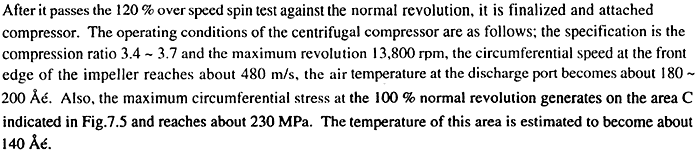
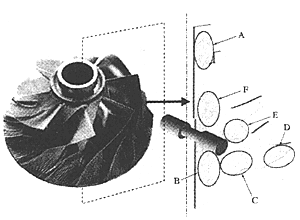
New forging processes have been studied to obtain a higher creep resistance material with longer lifetime and to achieve the higher speed rotation of the impeller under the same conditions as mentioned above. In the first place, the relationship was clarified between the mechanical properties and microstructure of a forged aluminum alloy "A2618" used as the impeller for centrifugal compressors. By the improvement of the forging process, the microstructure of the material was optimized. The modified impeller was produced. In the next place, the experiment was carried out using the conventional impeller and the modified impeller of the form as shown in Fig.7.5. On the test pieces of the area indicated in right side of the same figure, the mechanical properties and microstructure of a forged aluminum alloy were investigated down to the minutest details by an optical microscope, an electronic microscope, an x-ray analyzer, a breaking strength tester, a creep resistance tester and so on. Elastic-plastic analysis by the finite element method (FEM) was performed to predict the distribution of the stress generated in the impeller. As a result, on the microstructure of the conventional type, macro flaws of A19 (Ni, Fe) chemical compounds were stratified widely at the interval of 10mm~some hundreds mm, the largeness of the crystal particle was a few mm~200mm. Otherwise, on the modified type, macro flaws of the same chemical compounds were arranged at random and not stratified. Also, the largeness of the crystal particle was about 100mm uniformly at all area. On the mechanical properties, both of the conventional type and the modified type had almost the same breaking strength and the same 0.2% proof strength.