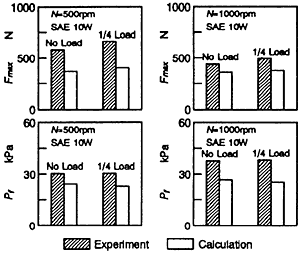
There is no significant difference among the experimental values of Pf. This is different from the calculation result. The experiments for the lubricants other than SAE10W also showed the same tendency. In the previous reports11) 19), the experimental results showed that Fmax decreased with the increase in the engine load. The difference between findings of the previous and the present studies remain unexplained. Further studies are needed.
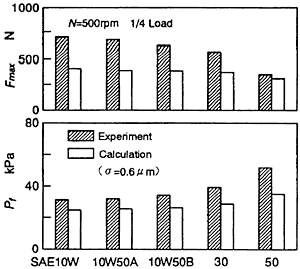
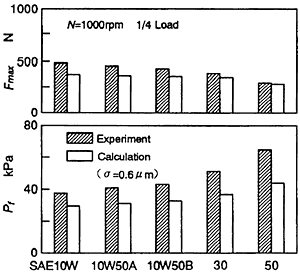
Fig.17 shows the effect of lubricant viscosity. The experiments using the monograde lubricants indicate that the Pf value was small and Fmax was large when the low viscous lubricant of SAE10W was employed. While the low viscous lubricant is effective to reduce the friction loss, it makes the lubrication condition at the beginning of the expansion stroke severe. On the other hand, the Pf values for the multigrade lubricants of SAE10W50A and SAE10W50B considerably decreased due to the shear thinning effect and were slightly larger than that of SAE10W. The HTHS viscosity of 10W50A is lower than that of 10W50B. Pf of 10W50A was small and Fmax was large compared to 10W50B. The lubrication condition becomes severe when the multigrade lubricant with excessively low HTHS viscosity is employed. An investigation of lower limit value for HTHS viscosity is also required.
Comparing results, there are comparatively good agreements in the qualitative tendency between the calculation and the experiment. However, the difference of Fmax value gets too large as the lubrication condition becomes severe. Further improvement of the analytical method is required.
5. Conclusions
The results obtained in the present study are summarized as follows.
(1) From the results on mixed lubrication analyses of the piston ring, it is found that effects of the ring surface roughness and the ring profile on the film thickness and friction characteristics are remarkable. The rough ring surface and the small roundness of ring sliding surface make the values of Fmax and Pf large and result in a severe lubrication condition.
(2) With the decrease in the lubricant viscosity, Fmax which occurs at the beginning of the expansion stroke increases because of the increase in the boundary friction while Pf decreases because of the decrease in the friction around the midstroke. Since the decrease in the engine speed has the same effect as the decrease in the lubricant viscosity, the friction coefficient at the beginning of stroke reduces with the increase in the bearing characteristic number while that at the midstroke increases. The piston ring operates in the regime of mixed and/or boundary lubrication at the beginning of stroke and in the fluid-film lubrication regime during the midstroke.