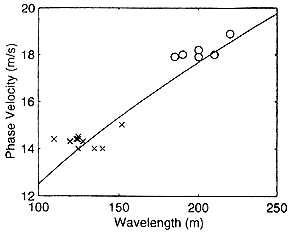
○ Izu Data
× Sanriku Data
─ Dispersion Relation
Figure 6: Wave phase velocity estimated from the cross-correlation function of the split-look images. The solid line is the phase velocity based on the deep-water dispersion relation.
4 まとめ
スプリット・ルック処理のSAR画像を使い重み付きクロス・スペクトルを算出し波浪方向スペクトルを得る最先端技術の理論と実例をJERS-1 SARデータを使って紹介した。本手法を実利用するには、波浪が画像として写っていることが必要なのはもちろんだが、正確なルック間の画像レジストレーションが重要である。本報告で使用したデータでは陸域を参照してシステマチックな位置ずれを確認したが、一般的な海洋では参照対象がないので、ルック間で位置ずれのない画像を生成できるプロセッサを必要とする。計測精度は、ルック間の時間差が大きい方が高いので、積分時間の長いJERS-1 SARの方がERS-1/2 SARより優れている。反面、JERS-1 SARは高入射角なので波浪画像のS/N比が低いという欠点もある。理想的には、20°~30°の入射角、空間分解能20m前後で、1.5秒以上のルック間時間差があれば波長100m以上の波浪方向スペクトルが高精度で計測されると考えられる。
参考文献
[1] K.Ouchi,“Multilook images of ocean waves by synthetic aperture radars,” IEEE Trans. Antennas Propagat., vol.35, pp.313-318,1987.
[2] K.Ouchi,“Determination of ocean wave propagation direction by split-look processing using JERS-1 SAR data,” IEEE Trans. Geosci. Remote Sens., vol.37, pp.849-855, 1999.
[3] G. Engen and H. Johnsen,“SAR-ocean inversion using image cross spectra,” IEEE Trans. Geosci. Remote Sens., vol.33, pp.1047-1056,1995.
[4] P.W.Vachon and R.K.Raney,“Resolution of the ocean wave propagation direction in SAR imagery” IEEE Trans. Geosci. Remote Sens., vol.29, pp.105-112,1991.