EXAMPLE Such conditions may be encountered on extended voyages, for example across oceans, or inshore when unsheltered from wind and waves for several hundred nautical miles.
3.1.2
design category B("offshore")
category of boats considered suitable for seas up to 4 m significant wave height and winds of Beaufort Force 8 or less
EXAMPLE Such conditions may be encountered on offshore voyages of sufficient length or on coasts where shelter may not always be immediately available.These conditions may also be experienced on inland waters of sufficient size for the wave height to be generated.
3.1.3
design category C("inshore")
category of boats considered suitable for seas up to 2 m significant wave height and a typical steady wind force of Beaufort Force 6 or less
EXAMPLE Such conditions may be encountered on exposed inland waters, in estuaries, and in coastal waters in moderate weather conditions.
3.1.4
design category D("sheltered waters")
category of boats considered suitable for waters up to 0.3 m significant wave height with occasional waves of 0.5 m height and a typical steady wind force of Beaufort 4 or less
EXAMPLE Such conditions may be encountered on sheltered inland waters in fine weather.
3.2
sailing craft
boat for which the primary means of propulsion is by wind power, having a total profile area, expressed in square metres, of all sails that may be set at one time when sailing closed hauled(Asp defined in ISO 8666) of greater than 0.7 (volumetric displacement of the boat with maximum load, in m3)2/3
4 Symbols
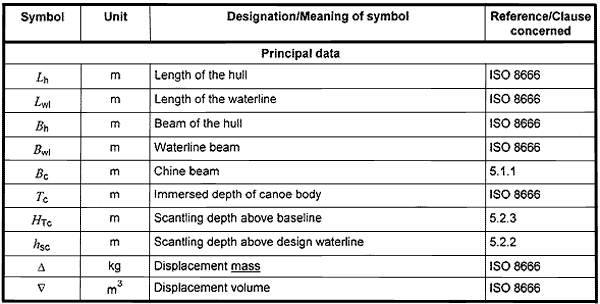
Unless specifically otherwise defined, the symbols shown in Table 1 are used in this International Standard.