MEMBERS OF ISO COMMITTEE 15370
National Institute of Technology
Building and Environment
Akersveien 24C, 0131 OSLO
Tel: +47 22865212
Fax: +47 22361829
E-mail: nerj@teknologisk.no
Your ref.:
Our ref.: Jonny Nersveen
Date: 99.09.28
COMMENTS TO ISO 15370 LOW LOCATION LIGHTING ON PASSENGER SHIPS
I have over several years been conducting research on lighting and visibility, and I am, amongst other things, the author of the book titled "A method of Calculating Visibility in Smoke", published by the publishers IGP AS in 1994. My comments to the ISO-/DTS draft are therefore on a specialist basis.
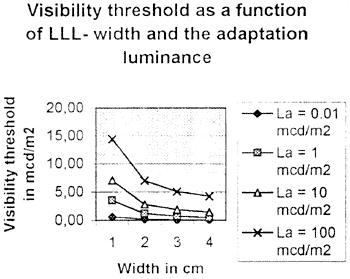
The draft connects the new LLL-requirements to a graph shown in annex E. I have made some calculations to control the validity of the assertion that a reduction in the width of the lighting strip from 8 cm to 3.5 cm will cause an increase from 2 mcd/m2 to 42 mcd/m2 when the requirements to visibility are constant. My calculations are shown in the graph below.
Figure 1: Visibility threshold as a function of LLL-width and the adaptation luminance.
The curves are calculated based on a viewing distance of 3 meters. The X-axis shows the width seen from an angle normal to a person in a corridor. When a strip is seen at a 45 degree angle, the strip will appear to be 70% of the real width. If you place yourself closer to the wall, the strip will appear to be even narrower. To make sure I have based my calculations on a width of 50% of the real width. This corresponds to a 60 degree angle in relation to the wall. I.e. when a strip of 5 cm, the perceived width will be 2,5 cm. The X-axis in the graph therefore corresponds to a width of 2 to 8 cm.