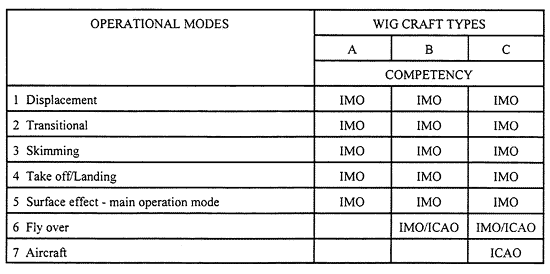
2.1.5 Since in the first three
operational modes WIG Craft does not practically differ from
HSC modes, it is reasonable to apply to its operation the
same COLREGs, Including exhibiting of an all-round flashing
yellow light in a skimming mode, by analogy with
non-displacement mode of an air cushion vehicle (regulation
23(b) of COLREGs).
2.1.6 Operation of WIG Craft in the
modes, 4, 5 and 6 differs essentially from operation of a
usual HSC. That requires entering of respective alterations
into a COLREGs.
.1 "Surface effect"
mode has no analogy either in shipping or aviation. Since
in this mode of operation, speeds of WIG Craft can be
from 10 to 20 times as big as speeds of usual
displacement vessels or twice-thrice as big as speeds of
HSC, only manoeuvres of WIG Craft are effective and this
is for that reason a COLREGs provision should envisage
this situation and WIG Craft shall avoid impeding navigation of all
other vessels. In order to let other vessels know such an
obligation of WIG Craft, it shall carry,
when in surface effect mode, in addition to an all-round
yellow flashing light, a special light (e.g. an all-round
red flashing light, similar accepted for aircraft in a
civil aviation). Thus in a surface effect mode the WIG
Craft should exhibit two additional all-round flashing
lights: yellow, showing that this high-speed vessel in a
non-displacement condition, and red, indicating on the
fact, that it is a WIG Craft, which comes off or already
has come off water, moves with very high relative speed
and shall avoid impeding navigation of all other vessels.
.2 "Take-off/landing"
mode is a transitional between "skimming" and
"surface effect" modes. It close to used at a
seaplane operation. Small WIG Craft can operate this mode
practically in any place. Large WIG Craft usually operate
this mode outside of other vessels way or in special
areas. However, as distinct from seaplane, due to various
starting devices application, the take-off/landing mode
of WIG Craft operation can be made under more severe sea
condition and at a shorter time. Therefore in a
"take-off/landing" mode expediently to keep
exhibiting of the same two additional lights, as in a
"surface effect" mode.
.3 "Fly over" mode is a
peculiar mode which can arise in an extreme case if it is
necessary to pass with other vessel or obstacle, when
other ways of maroeuvring can appear insuffirciently
effective. The opportunity of realization of such
manoeuvre in a vertical plane much increases operational
safety of WIG Craft. In a fly over mode WIG Craft shall
also avoid impeding navigation of all other vessels.
Therefore in this mode it shall exhibit the same
additional lights, as In a surface effect mode. These
lights shall be clearly visible from the vessel being
flown over.
.4 "Aircraft" mode
exists at a flight altitude more than 150 m and in this
mode WIG Craft shall obey with ICAO requirements.
According to aviation rules in this mode one additional
light - red all-round flashing could be left only.
However, in our opinion, it would be useful to leave and
the similar yellow light, that it was possible to
distinguish a WIG Craft from the aircraft and to take
into account peculiarities of it air-worthiness. The
decision of this question concerns to the ICAO
competence.