Standards in Daily Life
29th World Standards Day
14 October 1998
Each year on 14 October the members of ISO and IEC celebrate World Standards Day, which is a means of paying tribute to the collaborative efforts made by the thousands of experts worldwide who develop the voluntary technical agreements that are published as international standards.
Technical standardization is unlikely to cross the minds of many of us during the course of our everyday lives - yet we daily benefit from the "invisible" support of International Standards. They make so many aspects of life safer, healthier and more convenient, as well as ensuring quality and bringing us economic benefits.
To highlight this, "Standards in Daily Life" is the theme chosen for this year's World Standards Day by the three principal organizations responsible for developing international technical standards. The leaders of the three organizations say in their joint World Standards Day message: "From the moment you wake, throughout the day, standards in some form are helping to shape your day, to make it easier, more comfortable, safer and simply more convenient."
They give some practical examples: "Imagine, for example, not being able to withdraw money from an automated telling machine because your bank card is too big to fit in the slot; imagine batteries that will not fit any of your electrical equipment; stores without barcodes to quantify and price stocks of goods; imagine Internet sites without standardized domain names."
The heads of ISO (International Organization for Standardization), IEC (International Electrotechnical Commission) and ITU (International Telecommunication Union) acknowledge that we do not usually think about standards - unless their absence causes inconvenience.
"In today's world, where we expect fast, efficient communications, we demand compatibility and interoperability between electronic appliances, and we want our work tools, our consumer goods and our products to be cheap, easily available and of the best quality. International Standards are hence absolutely essential - even if most of the time they are so invisible as to be taken for granted."
Standards, say the ISO, IEC and ITU chiefs, provide the end-user with a criterion for judgement, a measurement of quality, and a guarantee of compatibility and interoperability.
"Whether it is a standard to ensure global linking of telephone networks, a standard to ensure that lifesaving medical equipment in the hospital is electromagnetically compatible, or a standard to help a company in providing a service that is quality managed and environmentally friendly, International Standards provide a veritable backbone for daily life. They encourage an improved quality of life by contributing to safety, human health and the protection of the environment."
ISO, IEC and ITU, whose scopes of standardization complement each other, form a complete system for the supply of voluntary international technical agreements. Published as "International Standards" or "Recommendations", these agreements are helping to bring about the compatibility of technology worldwide.
ISO, IEC and ITU leaders declare: "If machines, systems or devices work together, in many cases you have International Standards to thank for it - even if few are those that realize it." (The above is reprinted from the 3 September 1998 Press Release courtesy of ISO Headquarters.)
News from ISO
Technical Management Board (TMB)
continued from page 1
・ Transfer of ISO/CS responsibilities to TC/SC secretariats
- Preparation and issue of meeting notices and draft agendas
The TMB decided that the convening of meetings and issue of draft agendas should be fully delegated to TC/SC secretariats. TC/SC secretariats will be responsible for convening and issuing agendas for meetings held after 31 December 1998.
- Administration of the systematic review
The TMB, at its meeting in June 1998, decided that as of 1 January 1999, Committee Secretariats will administer the vote for standards subject to the systematic review. A new Form 20 for the systematic review is required. It is available in electronic form from ISO's ftp site at ftp://ttp.iso.ch/pub/out/directives/en.
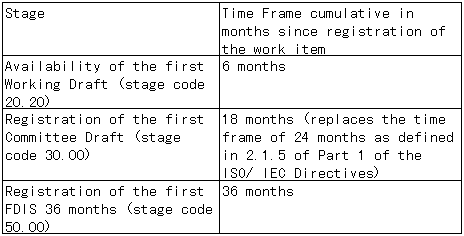
・ The TMB has agreed to the following timeframes for developing standards:
・ Use of the ISO template
The TMB recognized that a significant number of texts of DIS and FDIS are currently still submitted as paper copies or as electronic files which have not been prepared with the ISO template and do therefore not comply with the specification for texts to be submitted to the Central Secretariat. The TMB requested that by 1 October 1998 all texts of FDIS be submitted as electronic files prepared with the ISO template. All electronic files of DIS and FDIS have to be accompanied by a paper copy of the text because there is the possibility that automatic character substitutions will occur when files are moved between different IT-environments.
The Central Secretariat will refuse texts of DIS and FDIS if they have been submitted as paper copies only or if the files have not been prepared with the ISO template.
・ Performance approach in the development of standards
At its last meeting, the Pacific Area Standards Congress (PASC), requested ISO to draw the attention of ISO committees to the need to develop whenever possible, performance-based standards, i.e. standards in which technical requirements are expressed in terms of performance rather than design or descriptive characteristics in order to allow the development of different technical solutions to meet the same requirements (this methodology is known as the performance approach, which is also specified in clause 5.2 of Part 2 of the ISO/IEC Directives). The TMB asks ISO committees to give this approach adequate consideration in the development of their standards.