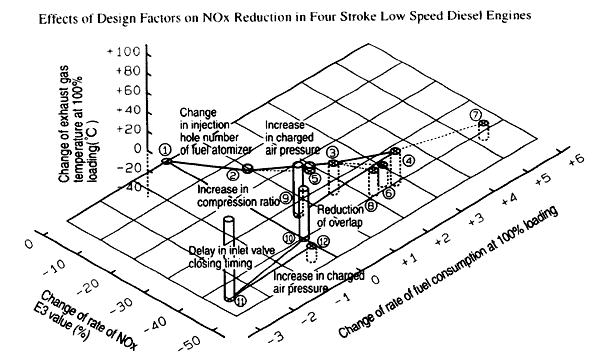
Fig. 7 Test Results
NOx was reduced by approximately 50% compared with the standard value if the Retarded fuel pump plunger (3]→8]) is applied to the final specification (12]).
5. Conclusion
The tests were carried out to reduce NOx only by modifying the design factors. The results are summarized below.
(1) NOx was reduced by 14% and the fuel consumption was degraded by 0.9% when the number of injection holes of the fuel atomizer was increased from 10 to 14.
(2) NOx was reduced by 32%, and the fuel consumption was degraded by 6.8% when the maximum pressure was reduced by 15%.
(3) NOx was reduced by 18%, the fuel consumption was degraded by 2.7%, and the exhaust gas temperature was dropped by 33℃ when the charged air pressure was increased by 29%.
(4) NOx was reduced by 11%, and the fuel consumption was degraded by 0.9% when the compression ratio was increased by 13%.
(5) NOx was changed little, the fuel consumption was improved by 3%, and the exhaust gas temperature was remarkably increased when the inlet/exhaust valve overlap period was reduced by 55°CA.
(6) NOx was reduced by 6%, the fuel consumption was improved by 2.6%, and the exhaust gas temperature was increased by 30℃ when the inlet valve closing timing was retarded by 45°CA.
(7) NOx was reduced by not less than 40% compared with the standard value, the fuel consumption and the exhaust gas temperature were equivalent to the standard values, by appropriately combining the above-mentioned items, and increasing the charged air pressure by 37% above the standard value.
(8) NOx was reduced by 11% by the Retarded fuel pump plunger.
The NOx E3 value could be reduced by not less than 40% without degradation of the engine performance such as the fuel consumption and the exhaust gas temperature by modifying the design factors without adding any special devices to the engine.
It is proved that the reduction by approximately 50% is possible if the Retarded fuel pump plunger is employed.
In the actual engine, the NOx emission rate is different from each other, and it is expected that the effect of the above-mentioned tests may appear differently.
It is also concluded that the IMO regulation in 2000 can be satisfied without damaging the engine performance by employing the methods suitable for each engine in a combined manner.
Discussions:
Questioner: Hiromi Kondo, Daihatsu Diesel Co., Ltd.
[Question]
We appreciate your extensive report on the changes in the parameters of the engine. Please explain the following items.
1. When various parameters are changed, the exhaust emissions including NOx are changed. In particular, it is believed to be important to take into consideration the effect of the kind of fuel oil. Is the objective fuel oil A-oil or C-oil?
2. In your report, the compression ratio is changed. Is it changed by the shape of the combustion chamber, or by other methods?
3. In the test results in Fig.7, NOx was reduced by 40% while the fuel consumption was degraded by approximately 5.5%.