The retardation limit for the practical use can thus be concluded to be 45。?A (approximately 11 in terms of the actual compression ratio) where the engine is surely started.
The exhaust gas color was white immediately after the engine was started, but as the load was increased, the white smoke disappeared, no black smoke was generated, leading to the excellent result.
The test results are shown in Fig.5 with the mark ○.
When the inlet valve closing timing was retarded from the standard value by 45° CA, NOx was reduced by 6%, and the fuel consumption was improved by 2.6%. The exhaust gas temperature was increased by 30℃.
4.6 Retarded Fuel Pump Plunger
The NOx emission rate of the 4-stroke engine having the turbocharger and the air cooler becomes maximum at the 10% load for marine use and minimum at the 100% load, and tends to be gradually reduced as the load is increased.
Though the weighting factor for calculating the E3 value is small, NOx reduction under the partial load is also an effective means.
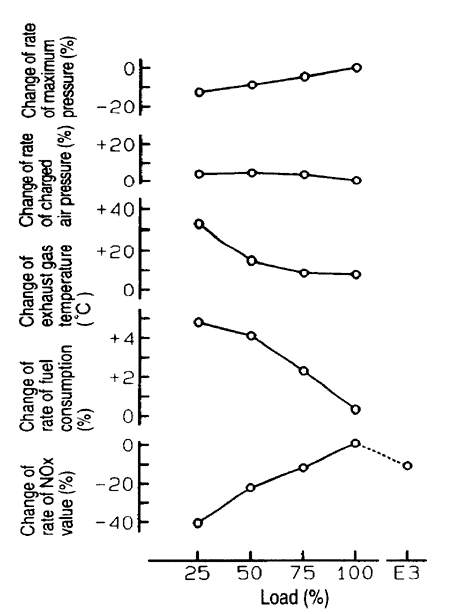
In order to reduce the NOx emission rate and to reduce the NOx E3 value under the partial load, the test on the Retarded fuel pump plunger to retard the fuel injection timing under the partial load was carried out.
The retarding quantity is the linear change from 0。?A under the 100% load to approximately 4。?A under the 25% load. The test was carried out in the condition where the charged air pressure was increased(by 22%)
Fig. 6 Retarded Fuel Pump Plunger
Each change is shown in Fig. 6 as the test result with the value under each load of the standard fuel pump plunger as the reference.
The maximum pressure was reduced by 5-13% under the partial loads, NOx was reduced by 12-41%, the fuel consumption was degraded by 2-4.8%, but each value was approximately same under the 100% load, and the NOx E3 value was reduced by 11%.
The exhaust gas color was excellent under each load.
4.7 Final Specification
In the condition specified in 4.5 above, i.e., in the condition of 14-hole atomizer, the increased charged air pressure (by 14%), the increased compression ratio (by 13%), the reduced overlap period (by 55°CA), and the retarded inlet valve closing timing (by 45°CA), the NOx was reduced by 44%, and the fuel consumption was improved by 2.4% compared with the standard condition, while the exhaust gas temperature was increased by 80°.
To drop the exhaust gas temperature, the charged air pressure was further increased up to the value above the standard value by 37%, and the overlap period was returned to the reduction by 35。?A.
The condition was indicated in Fig. 5 by the mark △. Compared with the standard condition, the fuel consumption and the exhaust gas temperature were equivalent to or less than the standard values, while NOx was reduced by 43%.
The process to the final specification (where the maximum pressure is constant) is indicated in Fig.7 using the representative points.
The abscissas indicate the fuel consumption and the NOx E3 value, and the height of the column indicates the change in the exhaust gas temperature.
The fuel consumption was degraded as the NOx was reduced in the processes of the change in the specification of the fuel valve (1]→2]), the increased charged air pressure and the retarded fuel injection timing(2]→3]→4]), the increased compression ratio and the retarded fuel injection timing (2]→5],3]→6],4]→7])
The reduction of NOx was small and the exhaust gas temperature was increased while the fuel consumption was improved in the processes of the reduced overlap period (4]→9]), the increased compression ratio (9]→10]), and the retarded inlet valve closing timing (10]→11]).
The final specification was determined in another increase in the charged air pressure (11]→12]), NOx was reduced by 43% while the fuel consumption and the exhaust gas temperature were same as the standard values.