4.2 Test to change Maximum Pressure (Change in Fuel Injection Timing)
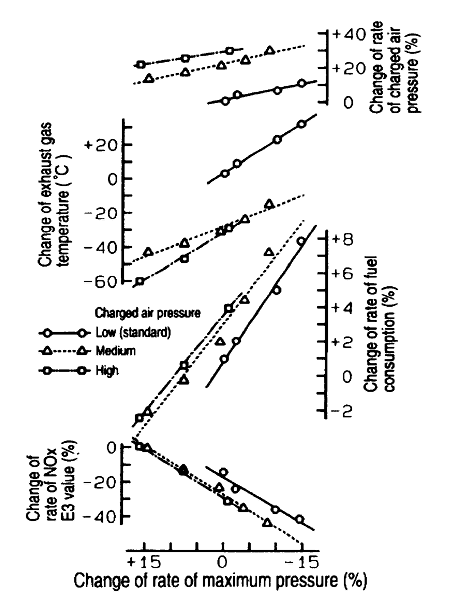
Studies were made on how the engine performance and the NOx emission rate were changed when the fuel injection timing is changed and the maximum pressure was changed which is most popularly performed in reducing NOx.
The tests were carried out in 3 conditions of (a) the standard low charged air pressure, (b) the medium charged air pressure and (c) the high charged air pressure.
The test results are shown in Fig.2.
In the condition of the low charged air pressure, when the maximum pressure was reduced by 15%, NOx was reduced by 32% and the fuel consumption was degraded by 6.8%.
NOx was reduced by 4.7% for the degradation of the fuel consumption by 1%, which was similar to the generally-accepted relationship between the degradation of the fuel consumption and the reduction in NOx, while the exhaust gas temperature was increased by 29℃.
Approximately same results were obtained in a case where the charged air pressure was increased.
In each case, the exhaust gas color was excellent.
Fig. 2 Change in Maximum Pressure
4.3 Tests to change Compression Ratio and Charged Air Pressure
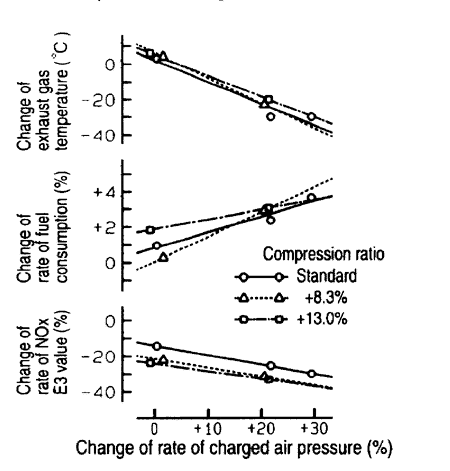
The charged air pressure change tests were carried out for 3 conditions where the compression ratio was standard, increased by 8.3% and increased by 13% while maximum pressure was constant.
The compression ratio was changed only by changing the length of the connecting rod without changing the shape of the piston, and the charged air pressure was changed by changing the specifications (turbine nozzle and diffuser) of the turbocharger, that is, in the standard condition, the condition where charged air pressure was increased by about 20%, and by about 30%.
The increase in the charged air pressure means the increase in the air volume related to the combustion, expecting the suppression of NOx generation caused by the increase in the air fuel ratio, i.e., the drop of the adiabatic flame temperature.
The test results are shown in Fig.3.
At the standard compression ratio, when the charged air pressure was increased by about 30%, NOx was reduced by 18%, and the fuel consumption was degraded by 2.7%. NOx was reduced by 6.7% for the degradation of the fuel consumption by 1%.
The exhaust gas temperature was dropped by 33℃ due to the increase of the blow-by air volume.
When the compression ratio was increased by 13%, NOx was reduced by 11%, but the effect of the retarded fuel injection timing was increased due to the improvement effect of the thermal efficiency, and the fuel consumption was degraded by 0.9%. NOx was reduced by 12% for the degradation of the fuel consumption by I%. The exhaust gas temperature was approximately same.
When the charged air pressure and the compression ratio were not too high, the reduction in NOx for the degradation of the fuel consumption was slightly larger in the case where the compression ratio was increased as the thermal efficiency was improved compared with the case where the charged air pressure was increased as the thermal efficiency was reduced.