Technical Papers
Effects of Design Factors on NOx Reduction in Four Stroke Low Speed Diesel Engines*
Koichi Tanabe**, Isao Honda**, Masaki Otani**
The examinations of NOx reduction are investigated on 3 cylinder test engine that has same dimensions as the commercial engines for marine use except number of cylinders, in order to comply with IMO Regulation NO. 13 only with modifications of engine design factors without using special devices such as SCR, EGR, emulsion fuel injection and so on.
The test contents following; verified number of injection holes of fuel atomizers, retarded fuel injection timing, increase of compression ratio and charged air pressure, reduced overlap period of exhaust and inlet valve opening, retarded inlet valve closing timing and adoption of fuel pump plunger with retarded fuel injection timing in low loads.
We have accomplished reductions by half of NOx E3 value and it seems there is good prospect of satisfying IMO Regulation No. 13 on commercial engines, in combination of constant combustion pressures with the tested design factors without deterioration of smoke, exhaust gas temperatures and fuel oil consumption.
1. Introduction
The regulation on NOx emission from the diesel engine for marine use will be enforced by IMO (International Maritime Organization) in January, 2000 or later.
The tests for NOx reduction were carried out so as to cope with the regulation only by changing the design factors without adding any special devices such as SCR, EGR and the emulsion fuel injection device to the engine.
The NOx regulated value aims at achieving the reduction of the average NOx emission rate of the average engine in the present status by 30% compared with the average value, but the NOx emission rate is different by the engine, and in a case of the engine with high NOx emission rate, the NOx emission rate is required to be reduced by not less than 40%.
The NOx reduction tests were carried out by setting the target reduction value of the NOx emission rate to be not less than 40%.
NOx reduction by modifying the design factors of the engine, that is, by changing the fuel injection system (including the retarded fuel injection timing), and by changing the compression ratio and the charged air pressure is accompanied by degradation of the engine performance such as degradation of the fuel consumption and the exhaust gas color and the increase of the exhaust gas temperature.
*Translated from Journal of MESJ Vol.33, No5 (Manuscript received Feb. 2, 1998) Lectured Oct. 22, 1997
**Hanshin Diesel Works Co.,Ltd. (Kisaki-Machi, Akashi City)
The target of the test includes suppression of the performance degradation to a minimum.
2. Test Apparatus
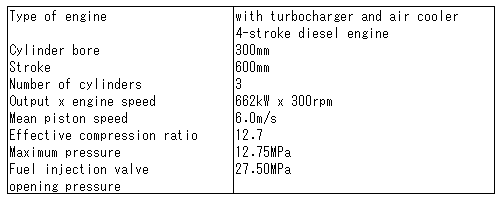
The test was carried out on the 3 cylinder test engine.
The particulars of the engine are indicated in Table 1.
The fuel used in the test was all A oil, and its results of analysis are indicated in Table 2.