4.3 Relationship between TG Mass Loss(%) and Carbon Contents
Fig. 5 shows the carbon content (wt.%) to the "TG mass loss in the temperature range between 300℃ and 500℃ and between 120℃ and 550℃" which is plotted on the toluene insolubles and the total samples. It is confirmed from the figure that the TG mass loss % and carbon content are very strongly correlated (correlation factor: 0.960 and 0.967), and the mass loss ratio in the range of the prescribed temperature by the thermal analysis can be regarded to be equivalent to the carbon content by composition analysis. As for the TG mass loss %, the correlation to the carbon content (composition analysis) in each temperature range is examined, and it is confirmed that the mass loss ratio in the temperature range between 330℃ and 550℃ is most strongly correlated.
4.4 Condition of Combustion and Residues
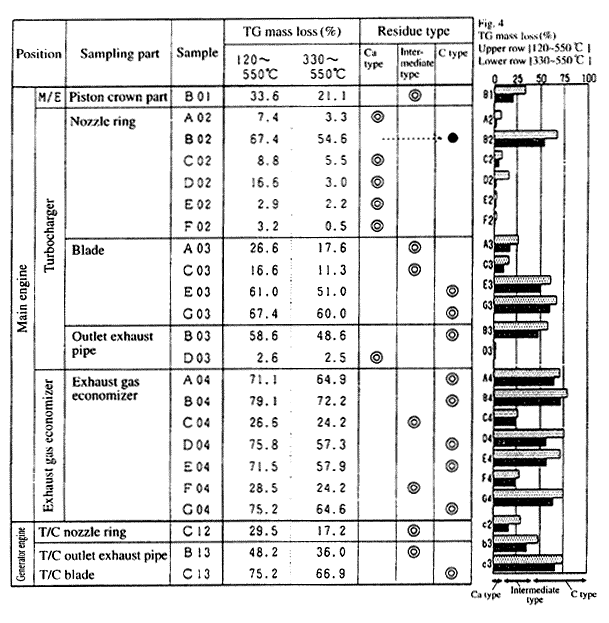
Fig. 6 shows the toluene solubles and solid carbon among the composition. As clearly shown in the figure, the samples from the exhaust gas economizer of the sample number "04" of each ship show abundant solid carbon on the whole, and the conditions where "soot" is deposited are clearly shown. On the other hand, because the quantity of solid carbon is small in the T/C samples A02-03, C02-03, D02-03, E02, F02, etc., it is estimated that T/C is the reason why it is difficult for the solid carbon to be deposited if the combustion condition in the combustion chamber is excellent. Thus, it is recognized that much solid carbon in the T/C sample of the generator engines of Ships B, E and G indicates the possibility of incomplete combustion.
The toluene solubles (unburnt oil part) is slightly higher in Ship B (B01), Ship E (E03), and Ship C generator engine (C12), and taking into consideration that the amount of solid carbon is large, incomplete combustion increases only solid carbon but also the unburnt oil part in the formation of the residue.