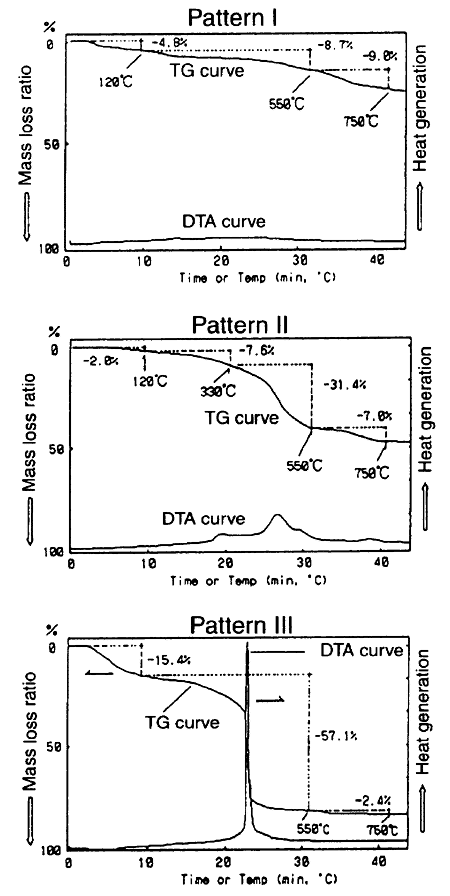
The characteristics in the thermal analysis of "Ca type residue" are that mass loss is small in the TG because the amount of solid carbon is small, and the heat generation peak in DTA is not remarkable.
However, at higher temperatures(above 550℃), mass loss not accompanied by heat generation is seen, which is presumed to be attributable to desorption of crystal water(H20)and description of carbon dioxide (C02) from the carbonate.
On the other hand, "C type residue" contains much solid carbon, which is burned(oxidized) through heating, and mass loss (TG) accompanied by heat generation is seen. For example, a sharp and large heat generation peak, seen around the temperature of 400℃ (22 minutes) of the DTA curve is caused by combustion of the solid residue. Because the amount of the inorganic component is small in the C type residue, the mass reduction attributable to desorption of crystal water or carbon dioxide in the high-temperature region above 550℃ is small. The"intermediate type residue" forms the intermediate composition or the thermal analysis curve between those of "Ca type" and "C type".
4.2 Standard for Classification of Type of Residues by Thermal Analysis
Heating mass loss(in the range room temperature-750℃)in the thermogravimetric analysis (TG) is based on the desorption and combustion of the adhered water, crystal water, unburnt oil, and the solid carbon contained in the sample, and different substances are desorbed and reduced in weight according to the range of the heating temperature. The mass loss in the temperature range between room temperature and 120℃ is presulmed to be attributable to the combustion of adhered water, that between 120℃ and 550℃ is presumed to be attributable to the combustion of crystal water and solid carbon, and that between 330℃ and 550℃ is attributable to the combustion of solid carbon, respectively.
In the thermal analysis, a part of the components of the residue is desorbed or burned in a composite manner, and it is difficult to quantify the specific substance with any degree of accuracy. However, in the classification of the "residue type" substance by thermal analysis, it is considered possible that the parameters of incomplete combustion can be mass loss in the temperature range (330-550℃) where the effect of crystal water is small on the whole, taking into account the solid carbon which can be measured in a generally stable manner.
The classification standards of the combustion residue using the TG loss % in the temperature range between 330℃ and 550℃ in the thermal analysis, is specified according to the residue type.
The residue of the main engine T/C nozzle ring is generally small in solid carbon, and the mass loss ratio in the temperature range between 330℃ and 550℃ is within 10wt.% except Ship B which is equivalent to that of Ca type residue.
On the other hand, the mass loss ratio is above 70 wt.% in the residue high in carbon content. However, because the inorganic component is contained in the residue in addition to the solid carbon, no residues close to 100 wt. % in the TG mass loss ratio are found. Thus, the residues of not less than 40 wt.% in the mass loss ratio are regarded as C type residue.