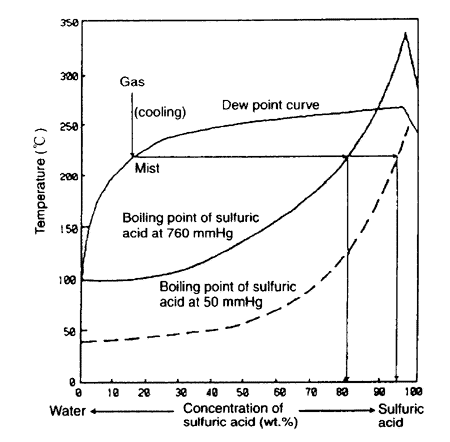
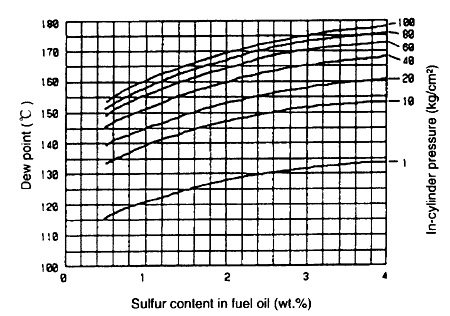
Reference Fig. 1 Relationship between dew point and boiling point of sulfuric acid
In addition, because the temperature of the exhaust gas is lower compared with the temperature of the exhaust gas immediately behind the combustion chamber on the downstream area away from the combustion chamber, a part of the sulfur in the exhaust gas is turned into mist as the temperature approaches the dew point of sulfuric acid, and adsorbed in the "soot" or "adhered water". It can thus be concluded that the residue deposited in the exhaust gas economizer indicates strong acidity.
The relationship between the boiling point and the dew point of sulfuric acid is shown in Reference Fig. I. The straight line (arrow) in the figure indicates the situation where the high-temperature gas containing sulfuric acid is cooled, and the sulfuric acid is turned into mist at the temperature on the dew point curve. It is also indicated that the dew point of sulfuric acid drops in a highly humid atmosphere.
It is thus considered possible that water can be present in the residue in the exhaust gas pipe at high temperatures above the dew point of water, and part of the sulfuric acid forms the mist and adheres to the inside of the exhaust gas pipe and is adsorbed therein.
Reference Fig. II indicates the dew point of sulfuric acid in the diesel engine, showing the general tendency between atmospheric pressure and the dew point of sulfuric acid.
3.3 Thermal Analysis
The result of the thermal analysis on the combustion residue is indicated in Fig. 2.
The mass loss in each temperature range in the TG curve, is believed attributable to the following phenomena (predicting from the components of the residue, the range of measurement temperature, etc.):
1) Mass loss up to 120℃ is caused by the evaporation of adhered water.
2) Mass loss between 120℃ and 330℃ is caused by volatilization and combustion of the oil content, and desorption of part of the crystal water.
3) Mass loss between 330℃ and 550℃ is caused by combustion of the solid carbon.
4) Mass loss above 550℃ is caused by desorption of carbon dioxide from crystal water or carbonate.
4. Results of Thermal Analysis and Examination
4.1 Classification of Residues by Thermal Analysis Curve
The thermal analysis curve (TG/DTA) of the combustion residue is roughly classified into three kinds of pattern shown below.
Fig. 3 indicates the typical "TG curve" and "DTA curve" of the combustion residue. In the figure, the mass loss ratio in the respective temperature range of 120℃, 550℃ and 750C.
1] Pattern I: Ca (calcium) type residue
Mass loss in TG is small, the mass loss ratio in the range of 330-550℃ is 10 wt.% or less, and no large heat generation peak is shown in the DTA curve.
2] Pattern II: Intermediate type residue
The mass loss ratio in the range of 330-550℃ in the TG is 10-40 wt.%, and the heat generation peak is shown in the DTA curve.
3] Pattern III: C (carbon) type residue
Large mass change is shown in the TG curve, the mass loss ratio in the range of 330-550℃ is not less than 40 wt.%, and a sharp heat generation peak is shown in the DTA curve.