One cause for the higher PM emission might be the higher sulphur content in BFO. But the stronger inrease of PM emission at low load can not be explained only by the higher sulphur content. Therefore, the BFO combustion characteristics will be discussed in more detail in the next section according to the visual study.
3.2 Evaporation Characteristics of Bunker Fuel Spray
In this section visualisation of both parts, liquid and evaporated, of the spray is discussed using the rapid compression machine (RCM).
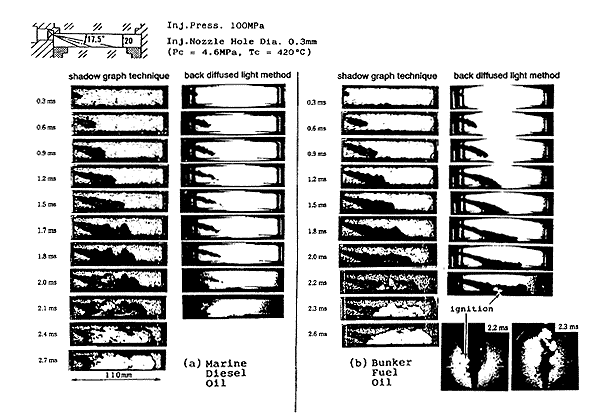
In Figure 3 the results of the visualisation is shown. The width of the observation window is only 110mm, but since side injection is used this simulates half of the bore of the real engine.
The fuel spray is observed using two different kinds of photo techniques. The outline of the spray including the gaseous part can be observed by the shadow graph technique, while the liquid part ot the spray is photographed before ignition by the back diffused light method. By combining the two techniques the structure of the spray can be verified. Fuel used is MDO in Figure 3 (a) and BFO in Figure 3 (b). When comparing the shadow graphs of the two fuels, it can be seen that both sprays impinge on the piston approx. 1ms after injection start.
Then both sprays expand along tile piston surface. However, if observed in detail, the upper surface of the MDO spray is not flat but shows some "hills", as can be seen between 1.7ms and 2.0ms. These hills are formed by counter-clockwise turbulence. On the other hand, in case of BFO the spray is thinner, without strong turbulence and therefore penetrating faster (clearly visible after 2ms).
A big difference between the two fuel sprays can be observed when comparing the liquid part of the sprays using the back diffused light method. In case of MDO the liquid part of the spray reaches a length of approx. 40mm within 0.9ms and remains this length for the rest of the injection duration. When combining the observations of the two methods, it becomes clear that the MDO spray evaporates within 40mm. After that it expands as gaseous spray. Therefore, the liquid core of the spray does not reach the piston. On the other hand, in case of BFO it can be seen clearly that a large liquid core remains which impinges directly onto the piston.
The ignition of the MDO spray occurs at approx. 1.8ms, while that of the BFO spray occurs at approx. 2.2ms. In case of BFO, the ignition appears to start at the bottom of the spray, but observation through the piston shows that it actually starts at the side of the spray, as shown in Figure 3 (b).