Technical Papers
Visual Study about Combustion Characteristics of Heavy Fuel in Diesel Engines*
Koji Takasaki**, Tadashi Fukuyoshi**, Shigenobu Abe**, Masayoshi Nakashima***, Shin-nosuke Osafune****
Bunker fuel oil, which mainly consists of residue from crude oil refining process, is commonly used for stationary and marine diesel engines. In spite of decreasing quality of bunker fuel oil during the last years, higher combustion efficiency and lower emission must be achieved. Up to today, ignition quality was the only criterion for combustion characteristics of such fuels. Therefore, contrary to gas oil, formation of the fuel spray and combustion process are not examined in detail yet. These are clarified in this paper, based on results from engine trials and visualisation of fuel spray combustion. Further, methods to improve combustion are discussed.
1. Introduction
Bunker fuel oil (BFO) mainly consists of residue from crude oil refining process. It is commonly used for stationary and marine diesel engines with a bore larger than 200 mm. Despite the fact that the quality of BFO is decreasing, high efficient and low pollutant combustion of diesel engines must be achieved.
Up to today, ignition quality was the only criterion for combustion characteristics of such fuels. However, spray characteristics and combustion process after the ignition are not well researched yet. Therefore, it is the purpose of this research to clarify the spray characteristics of BFO and its combustion process after the ignition.
In this research, the problem has been examined by four different methods.
1. Measurement of the emission from a real test engine.
2. Examination of the spray characteristics using a rapid compression machine (RCM).
3. Examination of the combustion process after the ignition using a visual engine.
4. Examination of the spray characteristics using computer simulation.
In all the experiments the apparatus used simulate engines of the same size, i.e. a bore of 200 mm. This is the most difficult size when using BFO.
* Translated from Journal of MESJ Vol.33, No.5 (Manuscript received Nov.10,1997)
** Kyushu University(Kasuga-Koen Kasuga City)
*** Mitsubishi Heavy Industries, Ltd. (Fukahori-machi Nagasaki City)
**** Mitsubishi Heavy Industries, Ltd. (Tana Sagamihara City)
2. Experimental Procedure
2.1 Experimental Apparatus
Test Engine
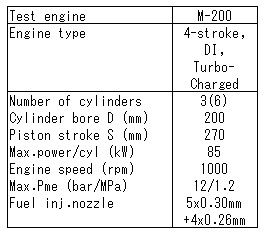
A turbocharged 6-cylinder BFO engine with 200mm bore is used for the test runs [1]. The specification of this engine is given in Table 1.
Rapid Compression Machine (RCM)
The RCM, explained in detail in [2], can be used to observe both, liquid and evaporated parts of the fuel spray. Since the RCM is equipped with side injection system, it can be used to simulate a 200mm bore, even though its bore is only 135mm.
Visual Engine
The visual engine, also explained in detail in [2], is used to visualise the combustion within the whole combustion chamber. It is actually a supercharged, 2-stroke single cylinder engine with a bore of 190mm.
2.2 Fuel
Three kinds of fuel are used in the experiments, namely gas oil (GO), marine diesel oil (MDO) and bunker fuel oil (BFO). Table 2 shows the characteristics of these fuels. When BFO is used it is preheated to a temperature of 105℃ in order to to obtain a viscosity of 20mm2/s.