3.3.3 Measurement of impedance
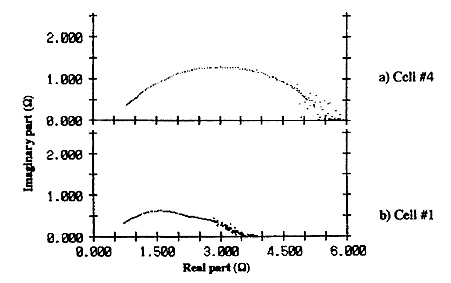
The results of impedance measurement on two cells of #1 and #2 are shown in Figs. 10a) and 10b), respectively. They show the complex impedance obtained when the electrodes and whole electrolyte are polarized by AC. In general, its real number indicates the value equivalent to ohm resistance and its imaginary number indicates the value equivalent to the capacitance at each part of the cell called the reactance. In both real number and imaginary number, #1 finished cell with larger surface roughness shows an arc with smaller resistance value, and the electrochemical resistance in the cell is reduced by surface finish. This also matches the trend of the inclination of the V-I curve at a current density of 0 obtained as the results of Fig. 5 and, therefore, it is considered to be the cause of the improvement of the power generation performance.
3.3.4 Load change follow-up capability
When a fuel cell is used as marine power, load change characteristics are important because of its use conditions.
Fig. 10 Comparison of Impedance Measurements
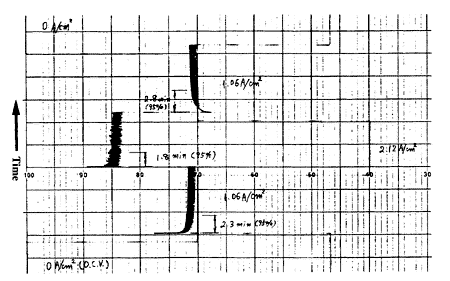
In general, for example, a current density is increased stepwisely under the stable condition at the current density of I= I0 and the voltage of V = V0, the voltage V is decreased largely once, and then recovers gradually to the next stable value. The results obtained for a surface finished cell are as shown in Fig. 11. The variation occurred approximately along the exponential function curve, and the time required for the voltage to recover to a stable value of 95 % was 1.8 to 2.8 min (that means time constant of 0.6 to 0.9 min). For conventional unfinished cells, an example of which load follow-up capability was as extremely low as 120 min (time constant of 40 min) was also found. For surface finished cells, however, the follow-up capability is considerably improved as compared with that of the conventional ones.
A time delay of a variation in V against a variation in I was considered to be caused by the gas diffusion delay in the electrode for the example of unfinished cell. Because the degree of follow-up capability was improved by a variation in boundary conditions by surface finishing, one of the causes of the problem is estimated to be the lack of 3-phase band comprising electrodes, electrolyte, and reaction gas through which the exchange of electrons is performed.
4. Reforming reaction and Power Generation Characteristics using Natural Gas as Fuel
4.1 Measurement Method
Figure 12 shows the conceptual drawing of the natural gas feed system. As fuel both hydrogen and, natural gas (methane) are used for comparison of performances. The fuel gas is humidified by bubbling in the water contained in the flask kept at a fixed temperature before it is fed to the cell.
Fig. 11 Load Change Follow-up Capability (Example when Roughness is Relatively High)