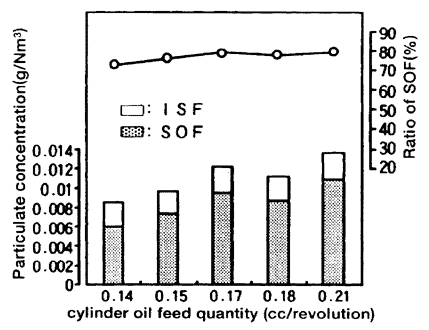
Fig.5 Relation between cylinder oil feed quantity and particulate concentration (Engine load: 25%)
Fig.5 shows the relation between the cylinder oil feed quantity and particulate concentration at a 25% load.The abscissa indicates the feed quantity for each revolution of the engine. Both concentrations of particulate and SOF increase with an increase in feed quantity. The ratio of SOF shows a slightly increasing tendency or rather is almost constant. From these results, a part of cylinder oil is thought to be converted into particulates (SOF) and be exhausted, therefore, the cylinder oil feed is thought to be a factor causing a difference in SOF emission between trunk-piston type and cross-head type engines.
3.3 Characteristics of SOF
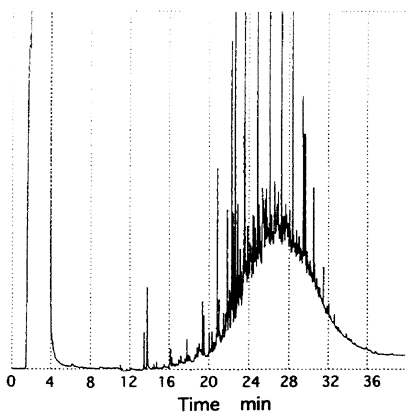
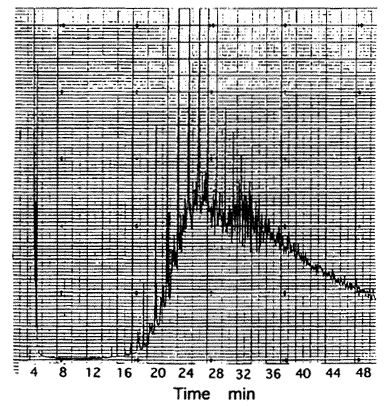
The SOF obtained by the experiment up to now was analyzed by gas chromatography to study its characteristics. Fig.6 shows the gas chromatogram of SOF at a 100% load as an example of the results obtained for the four-stroke engine. The patterns of paraffin components in the SOF are almost the same as those of components with boiling points higher than 300℃ in the fuel oil, so that most of the SOF is thought to be derived from the fuel oil. Fig.7 shows the gas chromatogram of SOF at a 85% load as an example of the results obtained for the two-stroke engine. In a retention time from 16 min. to 28 min., most of the SOF is thought to be likewise derived from the fuel oil since the patterns are the same as those of the four-stroke engine, however, in a longer retention time than 28 min., another peek appears and it conforms to the pattern of the gas chromatogram of the cylinder oil. As far as the gas chromatograms of SOF obtained at different loads for each engine were compared, the difference due to the effect of load on SOF components could not be confirmed in this time experiment.
Fig.6 SOF analysis result by gas chromatography (Four-stroke engine)
Fig.7 SOF analysis result by gas chromatography (Two-stroke engine)
4. Summary
In the experiment of the four-stroke diesel engine, SOF concentration decreased and ISF concentration increased with an increase in engine load. On the other hand, SOF concentration increased and ISF concentration decreased with an increase in excess air ratio. In the experiment of the two-stroke diesel engine, both SOF and ISF concentrations increased with an increase in load, and the high rates of SOF were indicated in any load. According to the analysis results of SOF components, it can be seen that most components of SOF are derived from the fuel oil in the four-stroke engine, however, components derived from the cylinder oil are also contained in the two-stroke engine.We would like to express our appreciation to Mr. Shigeo Hori, the Traffic Safety and Nuisance Research Institute, for his cooperation in the extraction and analysis of SOF.
References
1) Marine Air Pollution Committee of the Marine Engineering Society in Japan, Journal of the Marine Engineering Society in Japan (in Japanese), Vol.32, No.6 (1997), 390.
2) ISO/DIS8178-1, RIC engines - Exhaust emission measurement - Part 1: Test bed measurement of gaseous and particulate exhaust emission from RIC engines, (1993).
3) Miyamoto, N., Journal of the Marine Engineering Society in Japan (in Japanese), Vol.28, No.1 (1993), 19.