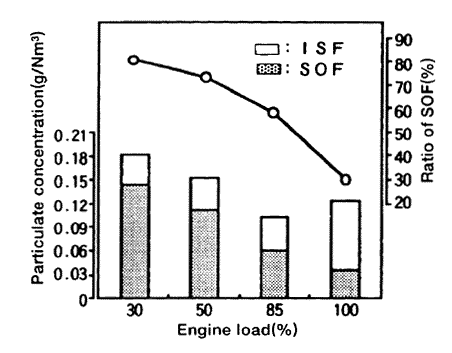
Therefore, the ratio and concentration of SOF are thought to become the highest at a 30% load.
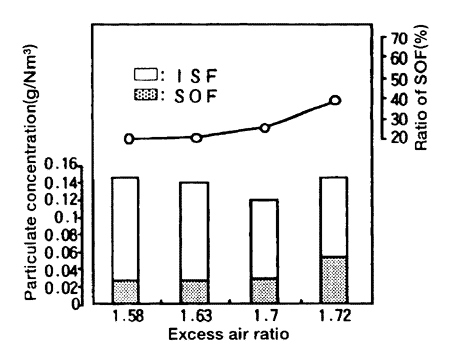
Fig.2 shows the relation between the engine load and particulate concentration at a constant engine speed. The ratio and concentration of SOF decreases with an increase in load while the concentration of ISF increases with an increase in load. As a result, the particulate concentration becomes a minimum at a 85% load. In this case, despite the increase of the load, the ignition delay did not largely change but the excess air ratio decreased from 2.6 at a 30% load to 1.6 at a 100% load. Fig.3 shows the result obtained when the intake air quantity was changed at a constant load (a 100% load), with excess air ratio taken on the axis of abscissas. From this result, it can be seen that the concentration of ISF decreases and that of SOF increases with an increase in excess air ratio. Consequently, the reason of the decrease of SOF concentration at high loads, as shown in Fig.2, is thought that the lean mixture zone is hard to be produced due to the reduction of excess air ratio and that the cylinder wall temperature rises at high loads.
The concentration of ISF is thought to increase because the produced ISF becomes hard to be oxidized due to the reduction of excess air ratio. This result differs from the operation in the propeller load operation in that the ratio of SOF changes from 80% to 30%. This is thought to be because the excess air ratio is largely changed with the load at the constant engine speed. The SOF concentrations are higher in the constant engine speed operation while the ISF concentrations are almost the same level in both operations; therefore, the particulate concentration is higher in the operation of the constant engine speed.
3.2 Experiment for Marine Two-stroke Diesel Engine
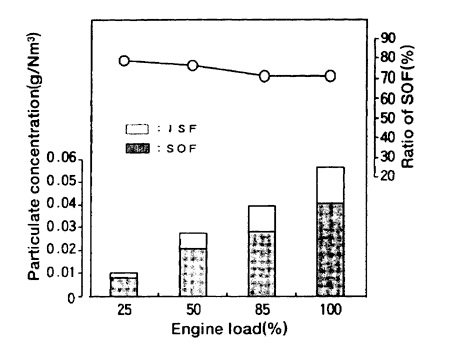
Fig.4 shows the relation between the engine load and particulate concentration in the propeller load operation. The concentrations of particulates, SOF, and ISF increase with an increase in load. The rate of SOF, however, is not largely changed with the load. In comparison to the result of the four-stroke engine (Fig. 1), there are differences in that the particulate concentration is low, the SOF concentration increases with the load factor, and the ratio of SOF is large even at high loads. As a reason why there is this difference in SOF emission tendency, the following are pointed out: firstly at low loads the SOF concentration decreases because the flame does not reach the vicinity of the cylinder wall since the fuel injection quantity is small and the cylinder bore of the two-stroke engine are large, and secondly at high loads cylinder oil mist tends to be exhausted as SOF due to the high temperature of the cylinder wall.