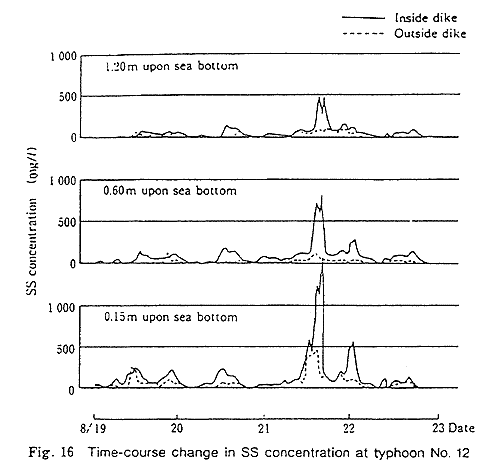
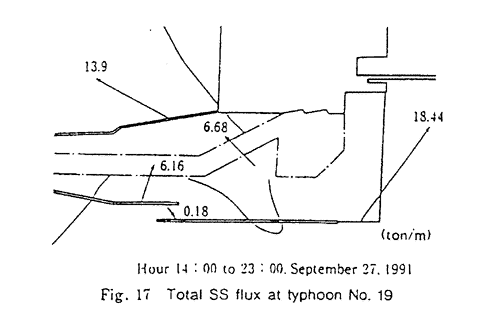
At the time of Typhoon No. 19 in September, 1991, current meters and turbidity meters were placed on the submerged dike and the entrance of boat and inside the dike into which suspend mud was expected to flow, so as to measure suspended siltation. Fig. 17 indicates SS flux totaled over a period during which high-concentration SS was measured. Compared with No. 12, Typhoon No.19 was very strong, resulting in relatively high SS concentration even on the dike and SS flux across the waterway. This SS flux is considered to be the cause of siltation at waterways. In summary a maximum of 30 cm of deposition was observed on the measuring plate installed within the waterway.
The submerged dike was stable free from settlement and dislocation even after the storm. Measurement and observation surveys will be continued until l993 so that relationship between the scale of the storm and the amount of deposition can be quantitatively evaluated.
Waterway deposition due to siltation poses very serious problems at not only Kumamoto Port but also at ports and harbours in Southeast Asia under the effect of tropical monsoon. It is thus highly anticipated that shoaling prevention technology at Kumamoto Port may be