the sea side) are subject to pull-off force, and therefore only back row piles were anticipated to produce resistance based on the conservative designing principle for safety. Adhesion between dike bottom surface and ground was not counted on in design since the dike inclines at an abnormally high resistance, thus receiving resistance chiefly from the piles, not from adhesion.
?C Repeated loading test
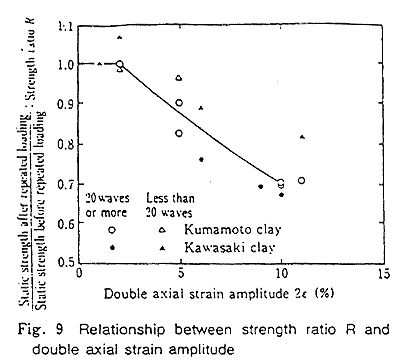
Repeated triaxial tests (for the period of 5 sec) and static triaxial tests (at the strain rate of 1%/min) were conducted to study deterioration of strength of the clayey ground at the dike bottom due to repeated wave load. Fig. 9 indicates relationship between strength ratios in the two types of triaxial test and double amplitude strain developed in the repeated triaxial test. The relationship indicates practical linearity between strength deterioration rate and strain. The finding that the double amplitude strain was 10% and that the strength ratio was 0.7 suggests that 30% strength deterioration must be considered in design.
?D Consideration of scour protection
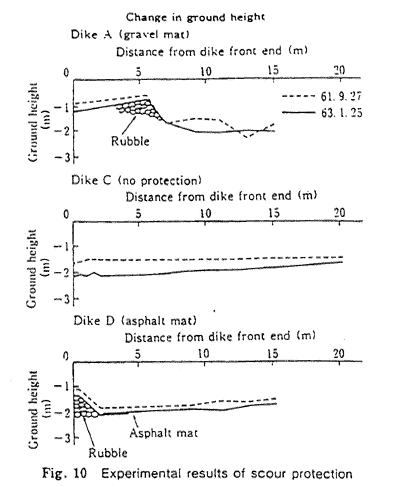
Scour protection is very important as a measure to prevent uplift acting on the settling dike. Hence, the installation of gravel and asphalt mats was studied, conducting field tests to compare changes in ground height between with and without provision of such measures. Fig. 10 shows the results. Since the use of asphalt mat reduced scour with the ground shape maintained in stable condition, asphalt mats are applied in practical work.
3.1.2 Design and Work Execution
The basic design cross section of Kumamoto Port south breakwater (soft ground dike) obtained from these considerations is as shown in Fig. 11. As scour protection, asphalt mats were laid at front. To stabilize the mats packed stones was provided as weight to the dike base. The H-steel piles penetrating concrete slab have a larger cross section coefficient than