|
VDR/AIS
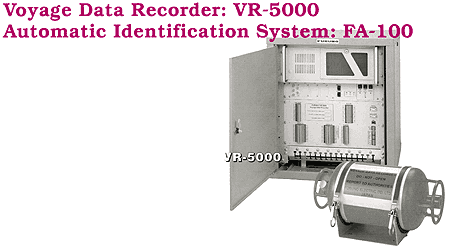
Voyage Data Recorder: VR-5000 Automatic Identification System: FA-100
The VR-5000 is a Voyage Data Recorder (VDR) designed to meet IMO A.861 (20) and lEC 61996 regulations. The revised SOLAS Chapter V requires the installation of a VDR on passenger ships of 150 GT and above, also on other ships of 3000 GT and above on international voyages for new building on and after 1 July, 2002. The purpose of the VDR is to help investigators locate causes of marine casualty and promote education for safe navigation.
Voyage Data Recorder (VDR) VR-5000
The VR-5000 consists of a Data Collecting Unit (DCU) and a Data Recording Unit (DRU). The DCU contains interface modules, a powerful computer and a status monitor. It collects data from sensors as required by the IMO and IEC standards. The DCU processes the incoming data and information in the order of occurrence, while old data is overwritten with new data for storage in the DRU. The recording time is a minimum 12 h with the standard flash memory. In case of an emergency supply failure, the dedicated reserve batteries enable the VDR to record bridge audio for 2 h. The DCU can be fitted with a Hot Swap HD for storage and retrieval of voyage data for periods up to several weeks. The hot swap system and an external docking station for the HD allows data to be retrieved without interrupting the mandatory data collection.
The Data Recording Unit (DRU) stores the data coming from the DCU in the flash memory. All essential navigation and status data including bridge conversation, VHF communications and radar images are recorded. The data can be retrieved by using the playback software for both accident investigation or educational briefing purposes. The DRU components are embodied in a protective capsule. The capsule ensures survival and recovery of the recorded data after an incident. An acoustic pinger helps locate the capsule.
Automatic Identification System (AIS) FA-100
The FA-100 is a universal shipborne AIS capable of exchanging navigation and ship data between own ship and other ships or coastal stations. It complies with IMO MSC.74(69) Annex 3, A.694, ITU-R MA.371-1 and DSC ITU-R M.825. It also complies with IEC 61993-2 (Type testing standard). IEC 60945 (EMC and environmental conditions). The FA-100 consists of VHF/GPS antennas, a transponder unit and several associated units. The transponder contains a VHF transmitter, two TDMA receivers on two parallel VHF channels, a DSC channel 70 receiver, interface, communication processor, LCD display, and internal GPS receiver. The internal 12-channel all-in-view GPS receiver with a differential capability provides UTC reference for system synchronization to eliminate clash among a multiple users. It also gives position, COG and SOG when the external GPS fails. The LCD panel displays all required information about Static data, Dynamic data, Voyage related data and Short safety-related messages. The information and messages are automatically updated according to the ITU-R MA3.71-1, e.g., static information every 6 min and on request, dynamic information every 10 s on ship faster than 3 kt and 3.3 s when changing course at 0-14 kt, etc.
 |
Furuno Electric Co.,Ltd.
Marchant Marine Marketing Department
Address:9-52,Ashihara-cho,Nishinomiya,Hyogo 662-8580
Matsue's Pistons Leap into Global Market
Matsue Diesel Co., Ltd. was established as a marine engine maker in 1943. At that time, Matsue had a license agreement for diesel engine and gas turbine parts with Yanmar Diesel Co., Ltd. (present: Yanmar Co., Ltd.), Matsue's parent company. Later, Matsue started production of iron castings for industrial machinery such as compressors or refrigerating machine.
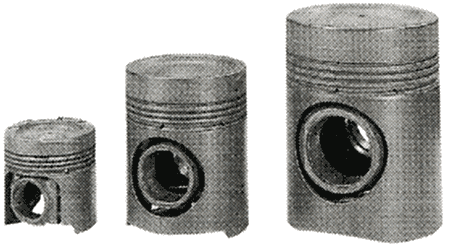
Matsue's major products are pistons, cylinder heads, cylinder liners and cylinder blocks for diesel engines. Its share of medium speed diesel engine parts in Japan's auxiliary diesel engines market exceeds 60%. Due to its enthusiastic pursuit of enhanced quality and cost efficiency, Matsue has increased the competitiveness of its pistons in terms of quality, delivery and price in recent years. As such, the popularity of its pistons, even in these major parts, is growing rapidly in the domestic as well as in the world market.
A basic description of Matsue's pistons is found below:
Material
・FCD700 Corresponding to ASTM A536 100-70-03
・Tensile Strength: 800 N/mm2
- In order to endure harsh conditions at high temperatures, nodular cast iron was developed by adding special alloy elements, controlling chemical compositions in a narrow range and performing special heat treatment.
Shape Type/Bore Size
・Mono Block Piston
・Composite Piston of Skirt and Crown (φ 160-400 for Both Type Pistons)
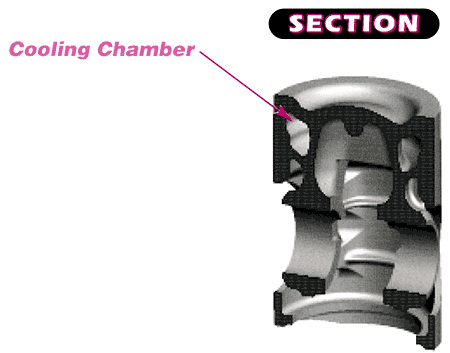
- In case of mono block piston, shape of the piston is complex because of the cooling chamber in the piston crown. Nonetheless, a stable supply of high quality pistons is provided.
Shape of Skirt
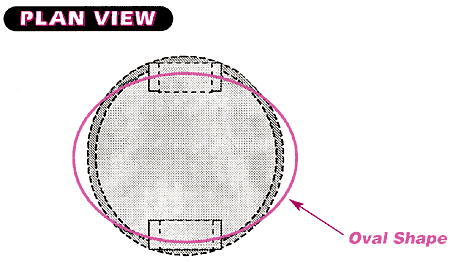
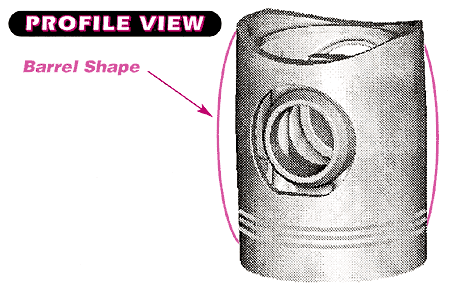
・Oval and Barrel
- Outer surface of piston skirt is machined by a special NC machine so that the outer shape of the skirt becomes both oval and barrel-shaped in order to absorb deformation of the skirt and avoid slapping against the liner wall during operation.
Production
・15,000 Pieces Annually
- Semi Mass Production by several kinds of dedicated lines by foundries and machine shops is carried out.
(3D mold filling and solidification analysis are used for shortening preproduction period.)
Quenching of Ring Groove
・Quenching by Laser Beam
・Hardness: Hv800
- In order to extend life of ring groove even under harsh conditions, ring grooves are quenched by laser beam. In order to do this, the optimum range and position of the grooves are quenched to optimum hardness by a fully automatic machine.
Surface Treatment
・Coating by a Dry Coat Lubrication
- Surface of skirt is coated by a dry coat lubricant to maintain optimum thickness during initial adaptation to cylinder liner and offer wear resistance to mechanical loads.
Quality
(Internal Examination)
・3D Mold filling and Solidification Analysis
・Radiographic Examination
- Before production of the prototype, these analyses are carried out in order to check soundness of the casting. Subsequently, soundness of the prototype is checked by radiographic examination.
(External Examination)
- Section shape of prototype is checked against the drawing by cutting the prototype after casting.
Matsue Diesel Co.,Ltd.
Address:960,Yawata-cho, Matsue, Shimane 690-0025
Tel:+81-852-37-1355 Fax:+81-852-37-0852
New Special Rudder for High-Speed Craft
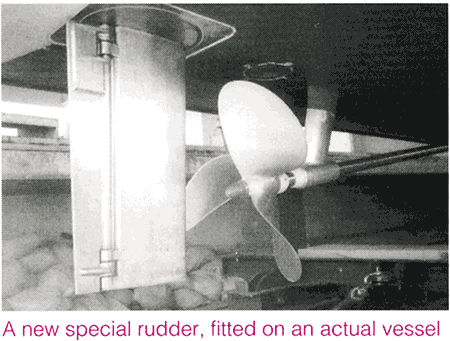
Nakashima Propeller Co., Ltd. has developed a new special rudder for use with high-speed craft. The newly developed rudder has flap, and is operated with double steering gears. At high speed the steering gear for the flap is used for maneuvering to restrain the force generated by flap, and at low speed the main steering gear provided at the top of the usual rudder stock is used to operate the main rudder and the flap at the same time via a link mechanism. The arrangement of the link mechanism within the hull is an important feature. This and other salient features of the new special rudder are outlined below.
(1) As the force generated by the flap can be differentiated according to the sailing speed, maneuverability is significantly improved.
(2) Though it is a high-lift rudder equipped with flap, the new product has no outboard projections which would generate resistance, because the link mechanism and other fittings are arranged inboard.
(3) The blades have a streamlined section, which contributes to reducing the rudder's own resistance while running at high speed.
■ Tank Test Results
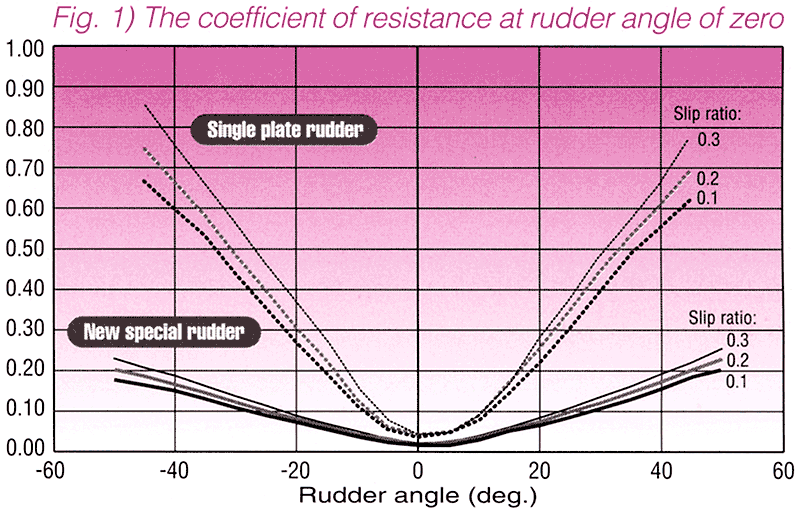
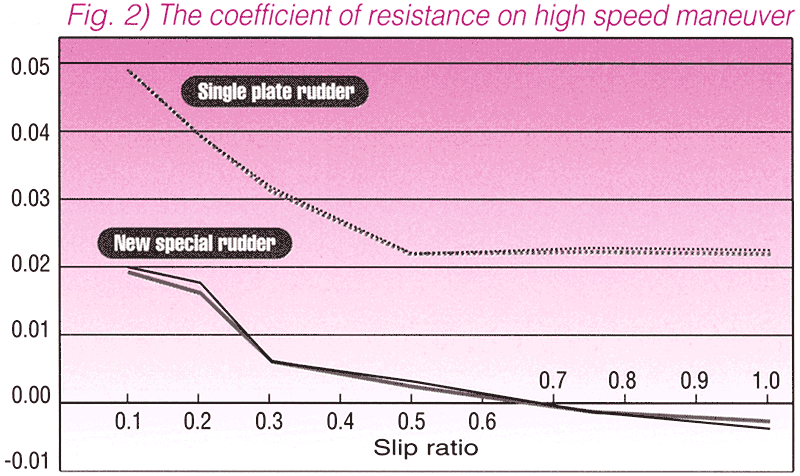
The tank test for developmental research on the new special rudder was carried out in the circulating water channel of West Japan Fluid Engineering Laboratory Co., Ltd. The test was conducted with two different rudders including a single plate rudder of which the width was 1/2 of and the height was equal to the propeller diameter and a rudder with flap. Fig. 1 shows the resistance coefficients during straight sailing (at a rudder angle of zero) at propeller slip ratios of 0.1, 0.2 and 0.3. As is seen from the figure, the resistance was found to be very low. The resistance coefficients when the rudder angle was adjusted both ways by 5° at a time are compared in Fig. 2. When only the flap was steered, the resistance of the new rudder at an angle of 10° or less either way was less than that of the single plate rudder at an angle of zero as shown in Fig. 2. On the other hand, the lift generated by the rudder was great even though only the flap was steered. The absence of any significant stall at a large rudder angle presumably is due to the role of guide plate as performed by the main rudder part.
■ Result of Tests with Actual Vessel
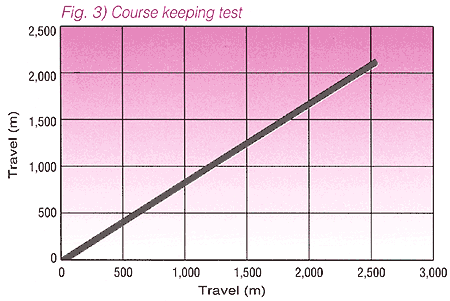
The test with an actual vessel were carried out using a small FRP-built fishing boat (of 15.21 m in length b.p.) with a speed of 30 knots. Fig. 3 shows a record of its wake during a navigation test by auto-pilot, tracked by the differential global positioning system (DGPS). It was found that, in spite of adverse sea conditions under strong wind and with white-crested waves, the operation of the flaps alone was sufficient for keeping the vessel's course. Photo shows an actual unit of the new special rudder, as fitted on the vessel for the sea test.
A new special rudder, fitted on an actual vessel
| (拡大画面:75KB) |
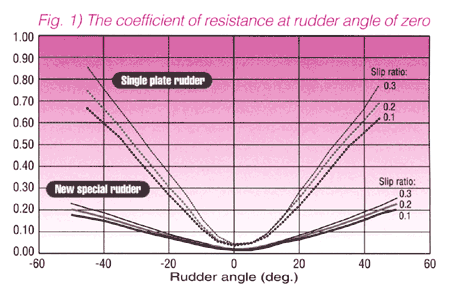 |
Fig. 1) The coefficient of resistance at rudder angle of zero
| (拡大画面:75KB) |
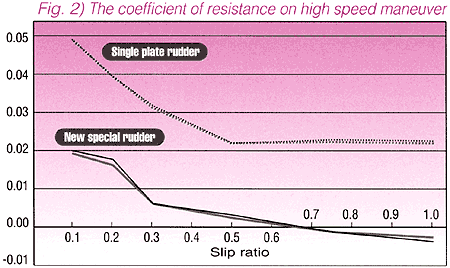 |
Fig. 2) The coefficient of resistance on high speed maneuver
Fig. 3) Course keeping test
Nakashima Propeller Co., Ltd.
Address:688-1,Jodo-Kitagata, Okayama 709-0625
|