|
10 Quality control
10.1 Test duration and fluid volume
The test measuring period (period that recovered oil is collected in the measuring tank) should be of sufficient duration to: 1) even out possible variations in test conditions during the measuring period; 2) provide a sufficient volume of recovered product to allow for accurate reading of both oil and water volumes, 3) perform the monitoring and recording requirements.
Table 1 specifies the minimum duration of the data collection period and the corresponding minimum recovered fluid volume for different expected skimming capacities (FRR). The prescribed fluid volumes and collection periods apply to each measuring tank.
Table 1
Expected FRR
(m3/h) |
Minimum recovered fluid volume
(m3) |
Minimum data collection period
(min) |
| 5 |
0.5 |
6 |
| 10 |
0.5 |
3 |
| 20 |
0.5 |
1.5 |
| 50 |
0.8 |
1 |
| 100 |
1.7 |
1 |
| 150 |
2.5 |
1 |
| 200 |
3.3 |
1 |
| 300 |
5 |
1 |
|
10.2 Repetitions
Performance data must be based on at least three tests performed under the same test conditions with an ORR standard deviation of less than 15%. Individual tests should be rejected if the individual test ORR deviates more than 20% from the mean.
11 Bibliography
ISO 16165 Ships and marine Technology. Marine Environmental Protection. Terminology relating to oil spill response
WORKING DRAFT
ISO/WD 21072
Appendix 1 Guidelines for controlling the thickness of a contained oil slick under influence of water current
The following provides guidelines for controlling the thickness of an oil layer contained in a boom. The method does not replace the need for in situ slick thickness measurements, but is designed as a supplement to such measurements, since few methods are currently available for rapid and reliable slick thickness measuring.
It is based on previous studies that indicate:
| ・ |
The thickness of the slick in a boom is nearly uniform, with
the exception of some thinning at the slick's leading edge and very close to the
boom. This is proven through measurements in the viscosity range 200 to 10.000
cP and at current velocities above 0.15 m/s. For conditions outside this range
empirical data is not available.
|
| ・ |
There is a direct relationship between the slick length and
the slick thickness and this relationship is unique for each oil type
|
| ・ |
Controlling the length of the slick and the current velocity
may approximately control the slick thickness.
|
| ・ |
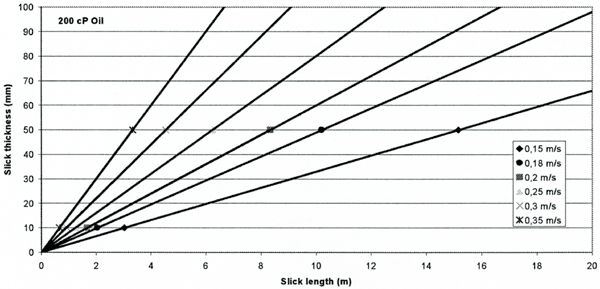
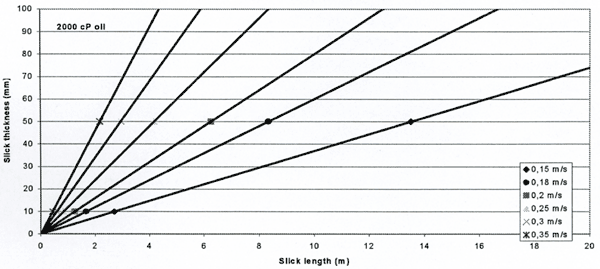
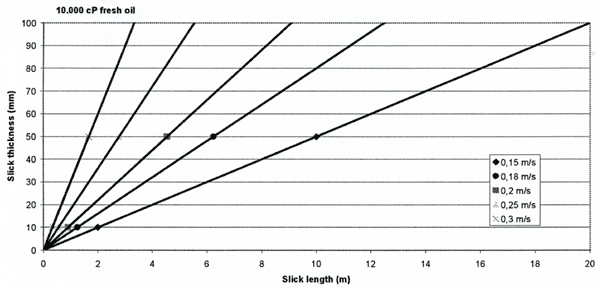
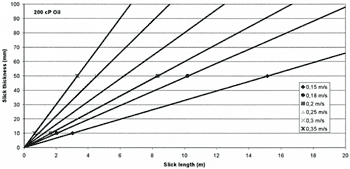
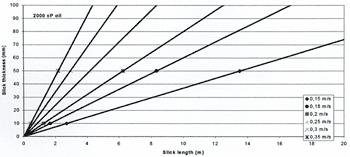
The relationship between slick thickness and slick length (as
determined by experiments) is given in the figures below for 200 cP, 2000 cP and
10.000 cP bunker oil with density in the 0.93 to 0.95 range. These are meant as
indications, and deviations will occur as a result of variations in density and
other properties. |
To obtain a specified slick thickness the following steps are suggested:
| 1. |
Identify the viscosity of the test oil |
| 2. |
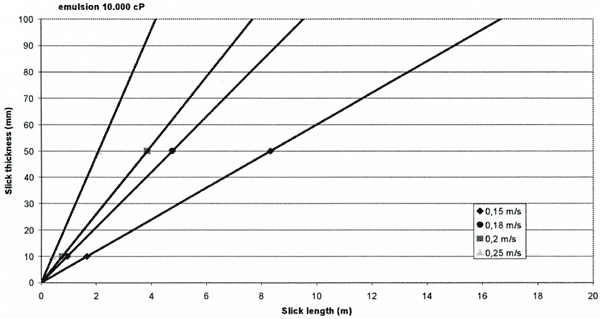
From Figures 2 and 3 identify the combination of current and
slick length that will produce the desired slick thickness. |
| 3. |
Identify the amount of oil to be preloaded in the tank. This
is calculated as slick length x slick thickness x tank width. |
| 4. |
Start the current and adjust to the desired speed |
| 5. |
Preload the test tank with the required oil quantity |
| 6. |
Measure slick length and slick thickness. If found to deviate
from the desired thickness, adjust by either removing oil or increasing the oil
quantity. |
| 7. |
When the desired thickness is achieved, measure the length
of the slick |
| 8. |
If testing is to be carried out with waves, start the wave
generator and adjust to the desired setting. Notice any slick length reduction
as a result of the waves. Reduce the current velocity until the slick's leading
edge is at its original position. |
| 10. |
Start the oil distribution system |
| 11. |
Throughout testing, adjust the pumping rate of the oil distribution
system to maintain the location of the slick leading edge. |
| 12. |
Verify that the slick thickness is maintained by measurements,
and adjust the slick length if required. |
| (拡大画面:63KB) |
 |
| (拡大画面:65KB) |
 |
| (拡大画面:63KB) |
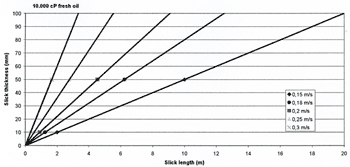 |
| Figure 2 |
Relationship between slick length and thickness for 200, 2000
and 10.000 cP oil |
| (拡大画面:67KB) |
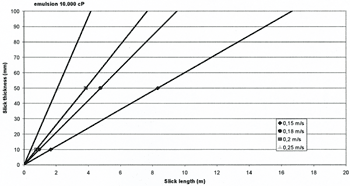 |
| Figure 3 |
Relationship between slick length and thickness for 10.000
cP w/o emulsion of bunker oil (at 10 s-1) |
|