|
7 Test Procedures
7.1 Preparations prior to testing
| a) |
Prepare the required quantity of test oil ensuring that the
oil properties are according to Table 1 with due reference to the water temperature
in the test basin.
|
| b) |
Measure and record oil properties as described in Section 9.1.
|
| c) |
Install the boom in the test tank.
|
| d) |
Locate skimmer inside boomed area. Ensure that the requirements
with respect to clearances specified in Section 5 are met.
|
| e) |
Start the water current and allow sufficient time for it to
stabilise at the desired current velocity (Table)
|
| f) |
Preload the tank with the test oil until the desired thickness
(Table) is obtained at the location 1.5 meters upstream of the skimmer inlet.
Note and record the location of the leading edge of the slick (length of the slick)
according to Appendix 1. |
7.2 Actions during testing period
| a) |
Start the skimmer and adjust the operating parameters to desired
settings (speed, draft, etc).
|
| b) |
Start the pump to offload recovered product from the skimmer
sump (if applicable). It is recommended wherever possible that the fluid level
in the sump be kept constant to prevent skimmer draft variations. Direct the fluid
to the Recovered Fluid Tank.
|
| c) |
Concurrently with steps (a) and (b), start the oil distribution
mechanism and adjust it to maintain the oil slick thickness at the measuring location
1.5 meters from the skimmer entrance. During periods between measurements, slick
thickness may be approximately controlled by maintaining the location of the slick's
leading edge (see Appendix 1).
|
| d) |
When steady state is achieved, divert flow of the recovery
fluid to the first measuring tank and maintain for the desired collection period
or until the desired volume is collected (see Section 10.1). Register time for
start of measuring period.
|
| e) |
Throughout the testing period, regularly monitor and control
slick thickness and skimmer operating settings. Record any deviations from the
desired test conditions.
|
| f) |
Once the measuring period is ended, divert flow back to the
Recovered Fluid Tank. Register time for the end of measuring.
|
| g) |
Provided that steady state is maintained, divert the recovery
flow to next measuring tank.
|
| h) |
Repeat points k to m for all measuring tanks.
|
| i) |
Stop oil distribution.
|
| j) |
Stop skimmer operation. |
7.3 Actions after testing
| a) |
Let the recovered fluid in the measuring tanks settle for at
least 30 minutes.
|
| b) |
For each measuring tank, record total fluid quantity, quantity
of water, and quantity of oily phase.
|
| c) |
Take at least three samples of the oily phase from each measuring
tank for subsequent analysis.
|
| d) |
Measure and record the water content in the oily phase samples
(test to be determined - DNV to advise)
|
| e) |
Calculate performance parameters as given in section 8. |
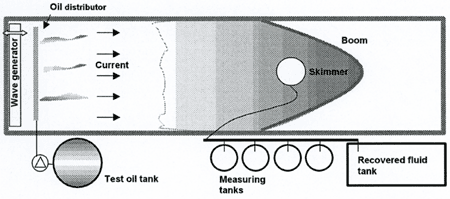
Figure 1 is a schematic representation of a testing facility arrangement.
Figure 1 Test facility arrangement
8 Performance parameters
Performance of the skimmer should be defined by the following parameters:
・Fluid Recovery Rate (FRR)
・Oil Recovery Rate (ORR)
・Recovery Efficiency (RE)
・Emulsification Factor (EF)
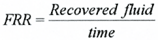
Fluid Recovery Rate (FRR)
The total amount of fluid recovered (in m3) divided by the duration of the data collection period (in hours).
Emulsification Factor (EF)
The Emulsification Factor (EF) is a measure of the tendency of the skimmer systems to form emulsion and is defined as the increase in water content (emulsified) in the recovered oil compared to the original test fluid. EF is expressed as a decimal fraction between 0 and 1 and is a function of both the test oil properties (eg. asphaltene, wax, resins) and the skimmer's design and operation. Therefore, EF comparisons are meaningful only for tests with identical oils. (Note: Water content to be determined in accordance with 7.3 d)
Oil Recovery Rate (ORR)
The total amount of the test fluid recovered (in m3) divided by the duration of the recovery period in hours. The ORR must be adjusted for additional water mixed into the oily phase in the recovery process (emulsification factor).
ORR applies to emulsions as well as fresh oils, since the additional water emulsified into the oil is subtracted
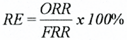
Oil Recovery Efficiency (RE)
The Oil Recovery Rate divided by the Fluid Recovery Rate expressed as a percentage.
9 Measurements and reporting
This section summarises those measurements that must be recorded in the final report.
9.1 Oil properties
The following test oil properties are measured prior to testing:
| ・ |
Viscosity (cSt) at the test temperature and at 20℃ (for comparison
purposes). Viscosity should be reported at shear rates of 1, 10 and 100 s-1. At
least two of these must be measured, while the third may be determined by extrapolation.
|
| ・ |
Density (kg/l) at test temperature and at 20℃
|
| ・ |
Pour point (℃)
|
| ・ |
Wax content (%)
|
| ・ |
Water content (%) |
After testing, the water content of the recovered oil must be measured to determine the emulsification factor (EF).
9.2 Environmental parameters
The following environmental parameters must be measured and recorded for each test:
・Air temperature (℃).
・Water temperature (℃).
・Current velocity upstream of the oil slick (m/s).
・Wave height (m), length (m) and period (s).
9.3 Skimmer operating parameters
The settings of the skimmer operating parameters must be reported. Examples of these include:
・speed of adhesion surfaces,
・pump speed,
・drafts,
・angles.
9.4 Other test parameters
Other test parameters that must be recorded include:
・Oil distribution rate (m3/h)
・Clearances to sides and tank bottom (m)
・Slick thickness (mm)
・Slick length (m)
9.5 Recovery parameters
For each measurement, the following must be recorded:
・Total recovered fluid (m3)
・Recovered oily phase (m3)
・Recovered water (m3)
・Duration of measuring period (min)
9.6 Performance parameters (calculated parameters)
Based on the recovery parameters (9.5), the following performance parameters must be calculated and reported ( see section 8): ・Fluid recovery rate (FRR)
・Oil recovery rate (ORR)
・Recovery efficiency (RE)
・Emulsification factor (EF)
9.7 Equipment specification and test documentation
The test report must include a technical specification of the skimmer unit tested and a narrative of the testing process. At a minimum the technical specification will include descriptions of the physical dimensions, construction materials, operating principle and power unit.
|