日本財団 図書館


3 Results
 
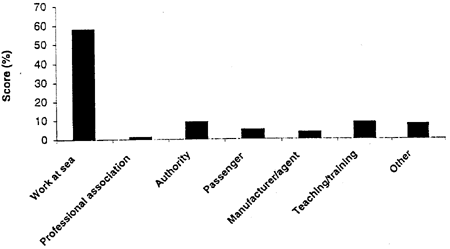
Figure 1 Distribution of responses organised by category of normative or interested body/user (n = 357).
 
 
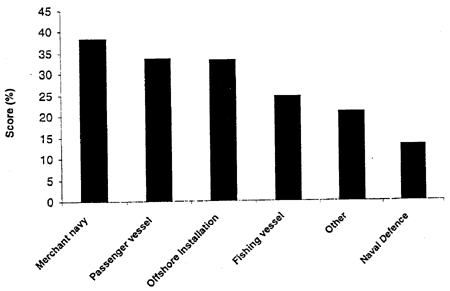
Figure 2 Distribution of responses organised by vessel/installation from which respondents have experience (n = 357).
 
Table 1 Information and training. Requirements personal life-saving equipment should meet in respect of information and training.
 
1 Information on the location of the personal life-saving equipment on board is provided in a conspicuous manner to all passengers.
2 The crew is trained every year, in realistic weather conditions, in the use of all life-saving equipment.
3 The crew knows the location of all life-saving equipment.
4 The personal life-saving equipment has Norwegian-language user's instructions, which are understood b both children and adults.
5 Information ensures correct use of the personal life-saving equipment.
6 The crew has tried the personal life-saving equipment.
7 The personal life-saving equipment is accessible so that passengers are able to familiarise themselves with it physically.
8 New knowledge on survival procedures is made known to all who train others in safety at sea.
9 Passengers are able to put on an personal life-saving equipment without assistance.
10 All passengers have tried the personal life-saving equipment
11 All passengers show that the can put on the personal life-saving equipment.
12 Information is provided on optimum underclothing to ensure that the personal life-saving equipment is as effective as possible.
 
Tables 1-4 show the requirements included in the questionnaire study for categories 1-4 (Information and training, On board, In the sea, Localisation). Figures 3-6 show the prioritised lists of requirements for all respondents. The requirement numbers on the horizontal axis corresponds to the numbering in tables 1-4. The prioritisation of requirements is shown graphically as columns in terms of score; percentage of respondents who have given priority to the actual requirement. In the same way, figures 7-10, 11-14 and 15-18 show the prioritisation categorised by passenger vessel, merchant navy and fishing vessel, respectively.
 
Table 2 On board. Requirements personal life-saving equipment should meet from an emergency situation arises to the evacuation is finished.
 
1 Personal life-saving equipment can be put on in the dark.
2 EPIRBs, communication equipment and emergency equipment can be operated by a person wearing personal life-saving equipment.
3 Personal life-saving equipment can be put on without taking off any outer garments.
4 Personal life-saving equipment is easy to find in the dark.
5 The storage locations of personal life-saving equipment for children and adults are clearly marked.
6 The functions of the personal life-saving equipment are more important than its comfort.
7 Personal life-saving equipment provides good mobility.
8 There is a clearly marked route leading to the personal life-saving equipment on board.
9 At the muster stations there is personal life-saving equipment which fits any likely user.
10 The zip-fastener on the personal life-saving equipment is easy to close.
11 Personal life-saving equipment does not cause personal injuries after jumps from 4.5 m.
12 Personal life-saving equipment stays in place on a person's body after jumps from 4.5 m without requiring the person to hold it in place.
13 Locking devices of personal life-saving equipment are easy to adjust.
14 Personal suits intended for crew members are clearly distinguishable from passenger suits.
15 There is 100% personal life-saving equipment capacity in cabins and/or under the seats.
16 There is 200% personal life-saving equipment capacity on muster stations to avoid running from one side to the other.
17 Personal life-saving equipment is flame retardant.
18 It takes one minute to put on the personal life-saving equipment.
19 Personal life-saving equipment is not damaged after jumps from 4.5 m.
20 Personal life-saving equipment covers the needs of today's traveling public for all sizes from infants to adults.
21 There is excess personal life-saving equipment capacity on board.
22 Personal life-saving equipment has fixed boots
23 Locking devices of personal life-saving equipment are capable of withstanding actual loads .
24 There is 100% personal life-saving equipment capacity on muster stations on deck.
25 Belts of personal life-saving equipment can be tightened in one movement
26 The parents of infants are given an appropriate life-saving appliance for their child when embarking.
27 Personal life-saving equipment is provided with light(s) which may work as emergency light(s) on board.
28 Personal life-saving equipment is comfortable to wear.
29 The immersion suit is put on early enough to avoid water ingress.
30 Personal life-saving equipment for children is located b the escape routes.
31 Boots have no-slip soles.
32 The immersion suit is automatically emptied of air when the wearer jumps into the sea.
33 Personal life-saving equipment is stored with o en buckles
34 Personal life-saving equipment has a range of boot sizes to fit the body of any likely user_
35 Personal life-saving equipment is without packaging.
36 Personal life-saving equipment is stored in all locations where people are found on the vessel.
37 Those who work at sea use woollen underclothing.
38 Infants wear their personal life-saving equipment all the time while on board.
 
Table 3 In the sea. Requirements personal life-saving equipment should meet from a person leaves the vessel/offshore installation to the person is rescued.
 
1 Personal life-saving equipment keeps a person floating face up.
2 EPIRBs, communication equipment and emergency equipment can be operated by a person wearing personal life-saving equipment.
3 The lifejacket is capable of turning an unconscious person.
4 Personal life-saving equipment does not prevent you from assisting others.
5 Personal life-saving equipment has a buddy line and a fastening point for buddy line.
6 Personal life-saving equipment gives protection against heat loss.
7 Personal life-saving equipment ensures good mobility when entering a raft/lifeboat
8 Personal life-saving equipment is provided with hoisting straps on the breast side.
9 The immersion suit is completely watertight.
10 Personal life-saving equipment protects hands and feet against the cold.
11 Functions of the personal life-saving equipment can be operated while wearing gloves.
12 Personal life-saving equipment protects against drowning when wearing ordinary clothes.
13 Personal life-saving equipment stays in place on the body regardless of sea conditions and movements in the sea.
14 Personal life-saving equipment ensures survival in water for 6-10 hours.
15 Gloves are fastened to the personal life-saving equipment.
16 Personal life-saving equipment protects the whole body against heat loss.
17 Personal life-saving equipment does not prevent you from swimming in agitated seas.
18 Personal life-saving equipment for infants protects against both drowning and heat loss.
19 Personal life-saving equipment prevents drowning in big waves
20 All vessels are provided with personal life-saving equipment giving thermal protection regardless of trade area.
21 Personal life-saving equipment protects against water ingress at wrist, neck and around face .
22 The immersion suit does not prevent turning.
23 Personal life-saving equipment protects head neck and body against heat loss
24 Personal life-saving equipment covering the whole body prevents a cold shock when going into the sea
25 Personal life-saving equipment prevents water ingress caused by water from waves and own movements through the water.
26 An inflated collar does not prevent rescue on board a boat.
27 Personal life-saving equipment has minimum 150 N buoyancy
28 Personal life-saving equipment materials ensure good friction against a hard surface.
29 Personal life saving equipment provides a freeboard greater than 12 em.
30 The amount of air in the personal life-saving equipment is determined manually to adjust buoyancy.
31 Personal life-saving equipment prevents you from drifting in the sea.
32 Personal life-saving equipment has detachable spray protection.
33 Hands and feet are less insulated to ensure better mobility.
 
Table 4 Localisation. Requirements personal life-saving equipment should meet in respect of localisation of people.
 
1 Personal life-saving equipment is provided with light(s) increasing its visibility in the dark.
2 All types of boat are equipped with EPIRBs Which are activated in emergencies.
3 Light(s) on personal life saving equipment are activated manually or by sea water.
4 Personal life-saving equipment reflects radar beams.
5 Personal life-saving equipment is provided with reflecting material on movable parts
6 The crew takes emergency communication equipment with them when the vessel is evacuated.
7 The crew's personal life-saving equipment is provided with a pocket EPIRB.
8 Personal life saving equipment is provided with a pocket EPIRB.
9 Personal life-saving equipment is provided with reflecting material on the back as well.
10 Ever 25th piece of personal life-saving equipment is provided with an EPIRB.
ll Personal life-saving equipment is provided with reflecting material on the strings.


日本財団図書館は、日本財団が運営しています。

  • 日本財団 THE NIPPON FOUNDATION