10.1.3 Needs for Oceanographic Observations
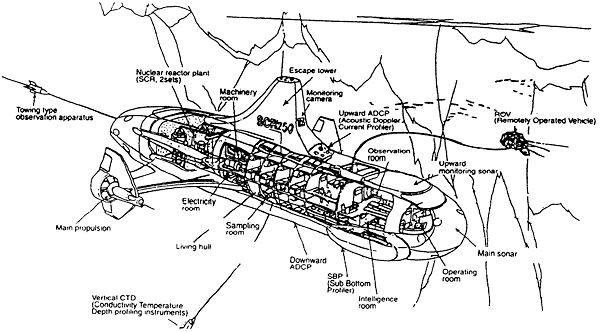
Trends in oceanographic research and development, priorities of requested items (including present and near-term future prospects), clarification of images of an undersea-navigating observation ship, and requested characteristics for a marine reactor called Submersible Compact Reactor (SCR) were examined by the Marine Reactor Research Committee of JAERI. The opinions of famed oceanographic researchers were reflected in this work to fit the SCR for utilization by researchers in the fields of global environment, ocean physics, and ocean biography. As a result, it was determined that the need is urgent for survey of the medium-deep-sea region in the area of the Arctic Ocean, survey and observation in the sub-Arctic zone, and for operation in stormy weather. It was also shown that a ship with undersea navigation capability will be necessary for these survey observations. How much power and how long a fuel supply interval are required for mission operations determine whether nuclear power is required. The advantages of nuclear power over conventional power sources are large, long-term out-put. Power demand and operation time of the under-sea-navigating observation ship were examined in detail for the mission and survey methods corresponding to the needs. From the examination, it was quantitatively shown that there is no suitable power source other than a nuclear-powered engine to meet the power demand. From these reasons, an undersea-navigating observation ship, with SCRs installed and capable of navigating in the Arctic Ocean as the main survey area, in the sub-Arctic sea area, and under stormy conditions, has been in the process of design and investigation. This selection would be reasonable so that it will be easy to obtain general comprehension of the need in relation to global environmental problems that are focused on problems on a whole earth scale that need to be solved in the near future. A conceptual image of the undersea- navigating observation ship with SCR installed (displacement weight of 500 tons) is shown in Fig.10.1. The SCR is based on the conceptual design of the DRX. The DRX was designed for a deep-sea stationary research ship of the 6000-meter class, which would move only vertically. No investigation has been conducted on the problems of three-dimensional operation and of the possibility of collision in the sea. The following design policies have thus been added to the design concepts employed in the DRX, such as an integrated PWR, reactor vessel with internal control drive unit, water-filled containment, and decay heat removal system by natural circulation:
1) Employment of a decay heat removal system that can remove heat in any direction of the hull when submerged, and
2) Separate housing of the secondary system, such as a turbogenerator.
The SCR is composed of a primary cooling system, Emergency Decay-heat Removal System (EDRS), Pressure Reduction and Make-up System (PRMS), power generation equipment, steam equipment, and feed water and condensing water equipment.