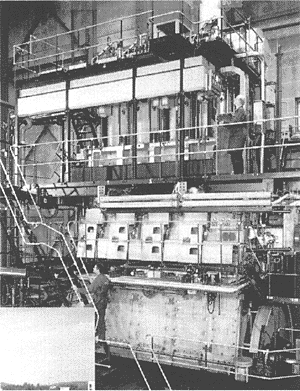
The three fuel injection valves in the respective cylinder cover are independently controlled so that they may be programmed to operate separately or in unison as necessary. As has been proven during test bed trials, the Sulzer common rail system is able to operate on the same grades of heavy fuel oil, namely up to 700 cSt viscosity.
In the Sulzer RT-flex concept, the single exhaust valves are operated in much the same way as existing RTA engines with a hydraulic push rod, like as Fig.2.4.6-4. Actuation of each valve is provided through the intermediary of an electronically controlled hydraulic actuator for each cylinder, which gives full flexibility for valve opening and closing patterns. These actuators are operated by hydraulic pressure from the hydraulic manifold, which is supplied by high-pressure servo oil pumps driven from the same gear drive as the fuel pumps.
All other functions on the RTX-3 Technology Demonstrator, such as starting air, cylinder lubrication, engine cooling, system lubrication oil, electrically driven Lanchester balancers (ELBA), etc., are electronically regulated within the Sulzer RT-flex concept using the WECS 9000 control system. For example, the starting air distribution to the cylinders is regulated by individual solenoid valves for each cylinder instead of the conventional mechanically driven air distributor.
Thus, with all functions operated by hydraulic pressure under electronic control, there is no need for the camshaft and its drive system. This allows a net reduction in engine weight and simplifies engine erection work. It also removes some physical constraints for future engine designs.
The RTX-3 engine is actually a prototype to prepare for the commercial introduction of the new Sulzer RT-flex series of camshaft-less engines which is shown as Fig.2.4.6-5. After completion of the evaluation trials of the RTX-3, one or more Sulzer RT-flex engines will be installed on board ship for operational trials in normal shipboard environments. The new Sulzer RT-flex engines will be commercially available around 2001.
2.4.7 Niigata Engineering Co.,Ltd.
(1) Development of new model
1) V22HLX type engine
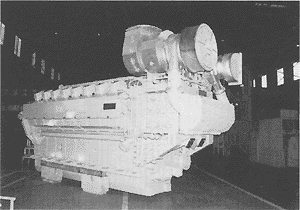
The V22HLX type engine was developed as a new model among the HX/HLX series medium speed engines which have many experiences in high reliability and economical efficiency as main engines for marine use and generator engines for land use. This engine is characterized in higher reliability with the high performance and easy maintenance as a V type engine from preceded L22HLX type engine, targeting the mean piston speed of 10 m/s and the brake mean effective pressure of 2.44 MPa. Table 2.4.7-1 indicates the principal particulars of V22HLX type engine and Fig.2.4.7-1 shows the general view of 16V22HLX type engine.
2) Niigata new medium speed engine series
The medium speed engine series which continues to develop with V28HLX type. L28HLX type and L22HLX type from the development of V34HLX type was completed from 1,392kW to 9,990kW by the development of V22HLX, above mentioned. The operation results are satisfied.