In the radial stage the impeller has an outlet circumferential speed of 515m/s, the blade outlet's back-ward angle is 55°, and the diffuser is a channel type.
For the axial stage, a variable stator vane V-type and a fixed vane F-type are being studied. For the V-type, in order to leave the pre-swirler at the outlet of the axial stage, the final stage vane is fixed and includes an inlet guide vane in the variable vane.
In the research and development of the compressor, CFD is being used to conduct cascade flow simulations and analyze performance, and a wide variety of performance tests are being conducted. Separate performance tests of the axial and radial compressors are also being performed. After determining the performance of each unit, the combined performance will be tested.
Rotary cascade tests are being performed to accurately evaluate and measure the performance and flow of the axial stage's initial stage. And compressor inlet casing model experiments are being carried out to determine the ideal shape for the casing to ensure uniformity of the axial stage's inlet speed distribution, and thereby minimize loss.
6.3.3 Gas generator turbine (GGT)
To ensure that the centrifugal stress levels on the blade and disc will permit use of conventional heatresistant alloy materials, the GGT uses an average blade speed of 400m/s. In this case, if a single stage is used a transonic turbine is needed to do the required work and efficiency can drop. To avoid this, a two-stage construction with a sub-sonic turbine is used to improve aerodynamic efficiency.
Both the first and second stages require cooled blades, but because increased cooling air can increase loss, highly efficient cooled blades are required which can cool efficiently using a minimal amount of air.
The turbine inlet temperature of 1,200℃ exceeds that of conventional gas turbines in this class. This means that an even higher performing cooled blade must be developed. To develop a high-performance cooled blade which also uses film cooling, blade cooling performance tests are being carried out under near-actual conditions. To determine the ideal cooling structure inside the blade, a large-scale model of the blade's interior is being used to study the thermal conductivity ratios and flow inside the blade.
6.3.4 Power turbine (PT)
Two PT types will be developed: the F-type with a fixed nozzle angle and the V-type with a variable nozzle angle at the first stage.
The F-type has a two-stage structure focusing on high efficiency at the rated output and has an average blade speed of 320m/s at each stage.
The V-type uses a variable nozzle in the first stage to improve thermal efficiency under partial loads.
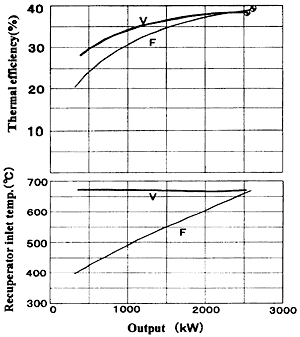
In the regenerative open cycle gas turbine, matching the most suitable recuperator inlet gas temperature and PT capacity (corrected gas flow rate) for each load level can raise thermal efficiency under partial load. PT capacity adjustment is accomplished by varying the mounting angle of the first-stage nozzle (varying the throat area).
Figure 8 shows a graph of the thermal efficiency under partial load for the V-type and the F-type (off-design values are estimates). For the V-type, the graph shows the thermal efficiency with the recuperator inlet temperature held steady, and one can see that thermal efficiency is greatly improved under partial load.
However, because leakage loss occurs from the clearance between the tip of the variable nozzle, it is important to predict this loss accurately. Model experiments of the variable nozzle (variable nozzle experiments) are being performed to precisely measure the aerodynamic properties and loss, etc., associated with the variable nozzle.
For the V-type PT, when the nozzle's mounting angle is varied in response to load, the aerodynamic loading in the variable stage under partial load can cause a reduction in turbine efficiency. To avoid this, variable loads at the rated output level are set small in order to prevent excessive aerodynamic loading across a wide range of operating conditions.