(2) The velocity ∂h/∂t is successively modified by the Newton-Raphson method so as to satisfy Eq.(12).
(3) After finding the velocity, a prediction of ho at a new crank angle is made by means of the improved Euler method. A locus of ho marched out. The iteration is continued until the steady locus is obtained.
3. Calculation
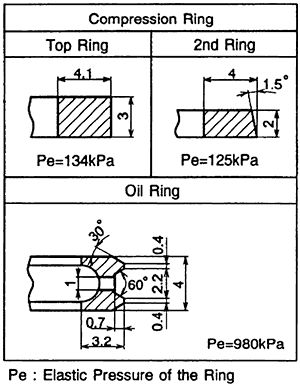
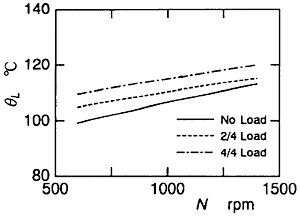
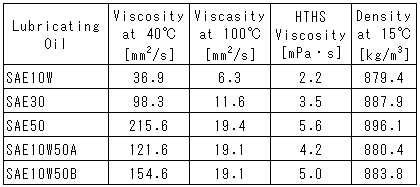
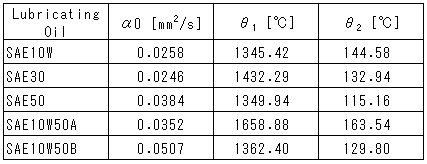
Mixed lubrication calculations are conducted for a piston ring pack in a four-stroke cycle, single cylinder diesel engine with the bore of 105mm and the stroke of l20mm. The piston has two compression rings and a 'two-lands' type oil control ring. The dimensions of each ring is shown in Fig.2. The axial shapes of the two compression rings are such that the top ring has a symmetric barelled face and the second ring has a composite profile of tapered and barelled faces. On the other hand, the 'land' shape of an oil ring is treated as a half of barelled face. The barell-faced profile of each ring is approximated by a parabolic curve. Three monograde lubricants of SAE viscosity grade, SAE 10W, 5AE30 and SAE50 are used. As multigrade lubricants, Two SAE1050 lubricants with different HTHS viscosity measured at 150℃ and 106 s-1 shear rates are selected and they are referred to as 10W50A or 10W50B. The lubricant properties are tabulated in Table 1 and Table 213) The constants in Eq.(10) relating the kinematic viscosity and the shear rate for the multigrade lubricants are chosen as b=0.493, c=2.43 and d=0.0218℃-1 for 10W50A while b=0.519, c=2.28 and d=0.0269℃-1 for 10W50B13). The lubricant viscosity is varied with respect to temperature distribution along the cylinder liner axis with the engine speed or the engine load. For the multigrade lubricants, the effects of temperature and shear rate on the viscosity are included. Fig.3 shows the change of temperatures at TDC of the top ring with the engine speed. The change of gas pressure in the combustion chamber with the crank angle is measured. The inter-ring gas pressure is predicted by the English method. The cyclic changes in gas pressures are shown in Fig.4. Piston rings and a liner are assumed to have an isotropic roughness with Gaussian distribution of height. The rms roughness of each ring σr is assumed to be 0.1 ~m in the present study. As the material properties and the surface parameters, the following values are used E'=228GPa, α=0.16, σ/β=10-4, τ o=2MPa, ηβσ=0.05.
Fig.5 shows the cyclic changes of the nominal instantaneous minimum film thickness ho and the friction force F for the top ring with crank angle θc at the engine speed N of 700 rpm and the 2/4 engine load.