MSC 70/20/11
Chapter 6 - Training
6.1 Introduction
The type of training depends largely on the
knowledge base of the particular person concerned. It is
envisaged that a set of model courses will be designed aimed
at setting out the requirements for basic training.
All stages of training, whether basic or on-the-job
should include continuous assessment. A task book (training
log) should be used to show progress being made by personnel
in their particular training. The log would show the number
of hours allocated and/or time in which each task was
completed. Training times should be dependent on the
experience, if any, of trainees. Training to work as a member
of a team should normally be part of the syllabus.
All training and assessment of VTS Personnel should
be:
.1 structured in accordance with written
programmes, including such methods and media of delivery,
procedures, and course material as are necessary to
achieve the prescribed standard of competence; and
.2 conducted, monitored, evaluated and supported by
persons qualified in accordance with §5.7
All training courses should be based on the model
courses associated with this Recommendation and be quality
approved and accredited by the Competent Authority concerned.
Basic training should be carried out at an Accredited
Training Institute.
Competent Authorities should ensure that the aims
and objectives of training are defined within an overall
training programme and that specific training objectives and
tasks are selected so as to relate as closely as possible to
VTS tasks and practices.
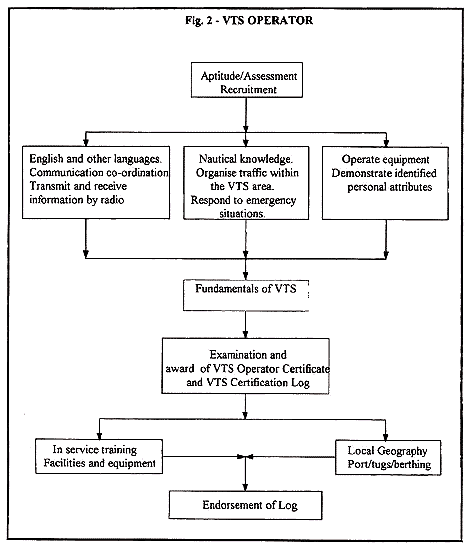
6.2 VTS Operator
The award of a VTS Operator Certificate and
endorsement to act as a VTS Operator should be achieved by
successfully undertaking the following steps:
Step 1. Basic training including:
- Use of the English language and other languages
authorised by the Government
- Nautical knowledge
- Operate equipment
- Organise traffic within the VTS area
- communication co-ordination
- Transmit and receive information by radio
- Demonstrate identified personal attributes
- respond to emergency situations
Step 2. Fundamentals of Vessel traffic
Services
- Information Service
- Navigational Assistance Service
- Traffic Organisation Service
Step 3 . Award of a VTS Operator certification
and a VTS Certification Log.
Step 4. "On-the-Job" training
Step 5. Award of an endorsement in the VTS
Certification Log.
I:/MSC/70/20-11.WPD


