AP216 Translators Cont..
The translators developed for the exchange of moulded forms are based upon a reduced sub-set of the full schema and subject to the EMSA Implementation Agreements. Effectively, this limits the scope of the data and thereby reduces the amount of code required by the developers of the translators. As with the ship structures translators reported on in the last issue, the schemas are extended over time in an incremental manner. This allows any problems in the data model, or in the export/import mechanisms to be rectified before enlarging the scope of the exchange.
Figure 1 shows a typical VLCC hull moulded form generated by NAPA with a surface patch representation, before enlarging the scope of the exchange.
Figure 1 shows a typical VLCC hull moulded form generated by NAPA with a surface patch representation, before exporting the data in a STEP file. Figure 2 is a view of the same ship (slightly different angle) after the STEP file was imported using the TRIBON system. For this part of the project, pre- and post-processors have been written by KCS using a late binding approach. The EXPRESS-X mapping facility (EDM STEP toolkit) has applied to define and utilise a convenient, customised intermediate EXPRESS schema.
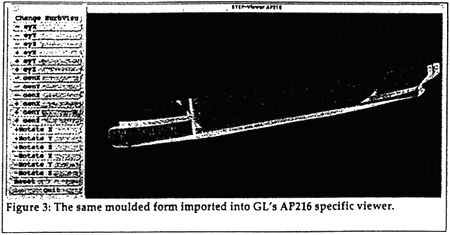
Figure 3 shows the moulded form surface patches imported into a STEP viewer from Germanischer Lloyd (based upon OpenGL), developed for an updated version of AP216, IST, Seasprite's Portugese University partner has also written import and export translators, although no images were available at the time of publishing.
Having established the basic exchange protocol, the partners will now carry out further test exchanges and extend the modelling towards a more complete implementation of AP216.
A further current EU project, Calypso (Computational Fluid Dynamics in the Ship Design Process), have decided to adopt the SEASPRITE AP216 model as a standard for the exchange of surface data which will be accessed by various flow analysis packages. This project will further extend the practical application of SEASPRITE.
Other EMSA members are encouraged to find out more about this and to consider participation in validating these business cases. Please contact Tim Turner for further details.
EMSA Sponsors AP218 Interpretation Workshop
The EMSA Board officially agreed (06 Feb 1998) to help fund the interpretation workshop by covering the cost of an interpretation expert (Julian Fowler) to lead the workshop. There was overwhelming support from the members to use the limited resources available to push AP218, the largest single Shipbuilding AP, onto the next rung of the ISO ladder. The meeting, planned over 2 weeks, may also be using a new mapping tool (RPG) called ITI, to help with documenting and verifying the mapping tables developed during the meeting. As an input to the meeting, LR is updating the mapping tables for AP216 following the recent changes to the model to make it compatible with the Ship Common Model and taking account of the comments from the ISO Shipbuilding (T23) Committee, the SEASPRITE and MariSTEP Projects and EMSA members.
EMSA Welcomes Fincantieri (I) and Vosper Thornycroft (UK)
Fincantieri, the Italian shipbuilder famous for Cruise ships such as those for Carnival has joined EMSA as a full member in 1998. Vosper Thornycroft, the UK yard specialising in small, high speed craft has joined EMSA as an observer in 1998. Along with the Italian Classification Society (RINA), this bring the number of members to 22 for EMSA in 1998. We look forward to their involvement and meeting them at the next Board and Technical meetings.
EMSA Selects Toolkit
The EMSA Technical Committee finally voted to select a toolkit to help support the EMSA Building Block Server. The toolkit testing resulted in a close battle between the two finalists; the EDM toolkit from EPM Technology and the Caselib toolkit from ProSTEP. Aftera period of further testing during which both toolkits were updated, the EDM tookkit eventually won out by a narrow decision, despite significant improvement in the ProSTEP tools during the time. The toolkit provides syntax checking, compilation, shortform based schema generation and html generation will be implemented in stages, first on a test machine and then moved onto the live system.
EMSA submits first Project Proposal: STRIVES
The proposal; STEP Requirements and Industry Validation for European Shipbuilding (STRIVES), is aimed at providing assurance that the Ship AP conformance classes shall be able to deliver data relevant to business perspectives through their verification and validation. In practice this will help to harmonise European industry requirements with the ISO Ship AP conformance classes, allow EMSA members to develop the associated