3.3.5 Influence of fuel injection pressure on BFO combustion (case C and G)
In case G, the number of injection holes is kept to (as in case C) but the diameter is decreased to 0.18mm, reducing the total injection hole area by approx. 60%. In order to keep the injection fuel quantity constant, injection pressure is increased from 1000bar to 1500bar and injection duration is extended from 22。?o 32。?rank angle.
According to the photographs in Figure 4, case G appears to have the best combustion. For instance, of all the cases the fewest soot is formed at the point of impingement. It can easily be understood that the combination of smaller injection hole diameter and higher injection pressure improves the combustion of BFO. In this case, however, the heat release rate shows that the combustion duration is extended because of the longer injection duration.
4. Numerical Simulation of the Fuel Spray
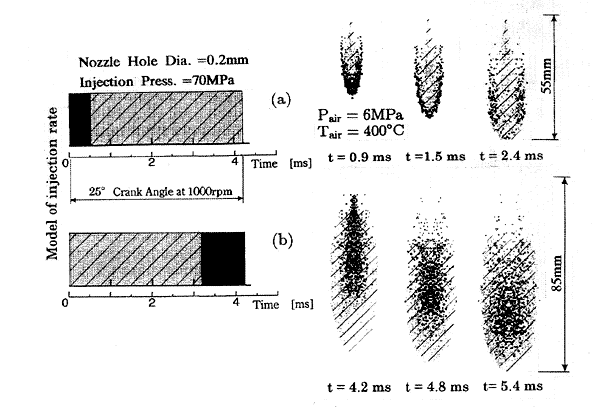
To understand the characteristics of the fuel spray in detail numerical simulation is performed using the software package KIVA [5]. In Figure 5 the calculation conditions and the results are shown.
The purpose of this simulation is to examine the distribution within the fuel spray, i.e. how the fuel injected at the beginning and the one injected at the end of the injection duration is spread out within the spray.
In Figure 5 (a) the distribution of the fuel injected at the beginning of the injection duration is examined. On the left the model injection rate is shown and on the right the result output. In the spray black dots represent the fuel injected at the beginning (first 1/8 of injection duration), also marked in black in the model injection rate. The rest of the fuel is marked grey plus hatching.
The fuel injected at the beginning of the injection duration is first located at the tip of the spray (t=0.9ms). It is then slowed down by the air drag. The rest of the fuel spray is then penetrating with high velocity and pushing the first part to the side (t= 1.5ms). At the end (t=2.4ms) all of the fuel injected at the beginning is pushed to the side of the spray.
If we assume that the fuel injected at the beginning also ignites first, then ignition would occur not at the tip but at the side of the spray, if ignition delay is long. In the photographs in Figure 3 (b) the ignition of the BFO spray occurs also at the side of the spray. This corresponds to the results of the numerical simulation.
In Figure 5 (b) the distribution of the fuel injected at the end of the injection duration is examined; the black dots representing the fuel injected at the end (last 1/4 of injection duration).
As observed in Figure 5 (a) the fuel injected at the beginning is pushed from the centre to the side of the spray where sufficient air is available for the combustion. However, the fuel injected at the end remains in the centre of the spray (t=4.2ms to t=5.4ms), because no spray is following to push it to the side.
In order to improve the diffusive combustion of the BFO spray it is important to induce air into this fuel- rich zone in the centre of the spray. This can be achieved by a combination of smaller injection hole diameter and higher pressure (as in Figure 4G), which improves the air entrainement into the spray during the whole injection duration.