The inlet temperatures both of the feed gas and of the solution for the absorber are 40 degree C. Heat loss through the walls of the both columns is neglected.
For CO2 liquefaction, it is assumed that CO2 is compressed from the state at temperature of 40 degree C and pressure of saturated steam at the stripping temperature up to the pressure of 2.08 MPa at CO2 saturation temperature of -18 degree C, where the compression efficiency is 80 %. The coefficient of performance of the liquefier is 3.5, and the refrigerant compressor efficiency is 80 %. The compressors are of multistage, and the compression ratio of each stage is less than or equal to 3, and is equalized.
In the calculation of heat transfer in the heat recovery boiler, the heater for the solution, and the reboiler, temperature differences at the pinch point and the terminal points are greater than or equal to 8 degree C.
The efficiencies of the electric motors and of the generator are 90 %. The steam compressor has an efficiency of 80 %. The efficiency of liquid circulation pump is 90 %.
The performance of the engine system is evaluated in terms of net output power, Pn, and a CO2 recovery ratio, αR. The net output power is the shaft output power from which the power for the booster, the steam compressor and the generator is subtracted. The CO2 recovery ratio, αR, is a ratio of mass flow rate of the recovered CO2 to that of CO2 in the engine exhaust gas.
The space requirement for the CO2 recovery equipment is evaluated in terms of the volume of the packed columns of the absorber and of the stripper, Vcol, as well.
4. Results of Calculation
4.1 Effects of Gas and Liquid Feed Rates
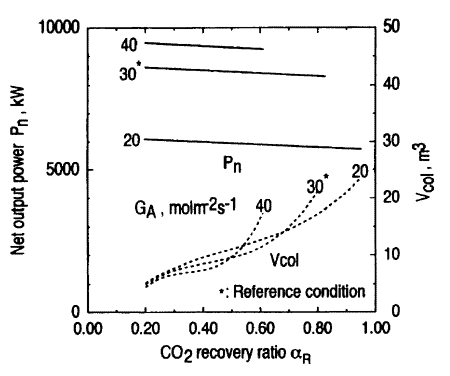
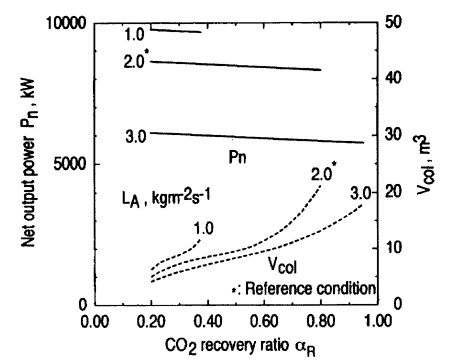
Figs. 4 to 7 show relations of the net output power, Pn, and the volume of the packed columns, Vcol, versus the CO2 recovery ratio, αR, where the varied parameters are the gas feed rate for the absorber, GA, in Fig. 4, the liquid feed rate for the absorber, LA, in Fig. 5, the steam feed rate for the stripper, Gs, in Fig. 6, and the liquid feed rate for the stripper, Ls, in Fig. 7; in these figures, the values of the other parameters are the same as those of the reference condition.
In Fig. 4 solid lines stand for the net output power of the three cases of the gas feed rate for the absorber.
At the gas feed rate, GA=40 molm-2s-1, decrease in the net output power is the smallest of the three but the attainable maximum CO2 recovery ratio is 0.6, which is the lowest. In this case, a part of the energy of the exhaust gas for turbocharger is used for CO2 recovery, so the booster requires power, about 20 % of total power for supercharging, which is the main cause of the reduction in the net output power.
At the reference gas feed rate, GA=30 molm-2s-1, power required by the booster increases up to about 65 % of the total supercharging power.
At GA=20 molm-2s-1, the net output power reduces much because the supplemental heat recovery boiler is used and the steam compressor is driven. The attainable maximum CO2 recovery ratio, however, reaches 0.95, which is the highest
In all the three cases the net output power gradually reduces as the CO2 recovery ratio, αR, increases because of increment of liquefaction power of CO2.
In Fig. 4 dotted lines stand for the total volume of the packed columns, Vcol. The total volume increases as the CO2 recovery ratio increases, and it steeply increases in the vicinity of the attainable maximum CO2 recovery ratio.