2. Solar-Hydrogen-Methanol Energy System
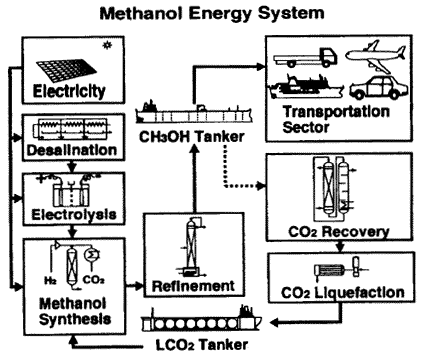
The transportation sector of Japan consumed energy of 90.81 Gliter on the converted crude oil basis in 1994 fiscal year, which is equivalent to 24.1% of all sectors consumption.(5) The consumption of the transportation sector is 1.81 times as large as that in 1975, the growth of which is higher than that of all sectors, 1.39 times. Further, the rate of petroleum consumption to total energy consumption by the transportation sector is constantly 98%. Considering future petroleum depletion, it is necessary to introduce reproducible energy into transportation sector in certain energy shape. One of the means is the solar-hydrogen-methanol energy system depicted in Fig. 1.
In the system of Fig. 1, solar insolation is converted to electricity with photovoltaic cells (PV cells) in an overseas land and then hydrogen is produced by way of electrolysis there. The hydrogen is converted to methanol with carbon dioxide transported from Japan. The methanol is transported by methanol tankers and delivered to the transportation sector. As for carbon dioxide, it is recovered from methanol tankers and power stations fueled with fossil fuels and methanol; after it is liquefied, it is transported to the site of methanol production.
In order to know the scale of the energy system, it is assumed that all the petroleum consumed by the transportation sector in 1994 will be substituted by methanol. The amount of methanol is 183.5 Mton on the conversion basis of lower heating value. The area of PV cells of 8,100 km2 is required, where assumed that solar insolation is 0.24 kW/m2 in Australian deserts and that the efficiency of PV cells is 10%.
Fig. 1 Outline of concept of a solar-hydrogen-methanol energy system
As for sea transportation, required number of 239 kton (DW) methanol tanker is 63 and that of 145 kton (DW) liquefied carbon dioxide tanker is 144, where assumed that transportation distance is 8,900 km; tanker service speed is 15 kt; loading capacities of the tankers are estimated on the basis of configuration of 260 kton (DW) petroleum tankers.
3. CO2 Recovery from Diesel Engine
3.1 Overall Engine System
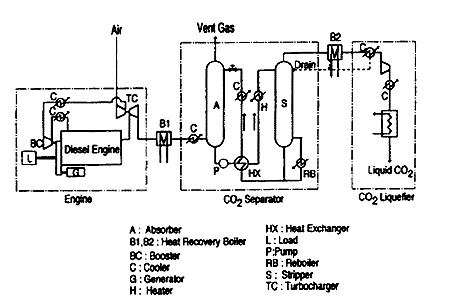
Fig. 2 shows a schematic of a diesel engine with a CO2 recovery equipment.
The CO2 separator consists of an absorber, A, and a stripper, S, with a packed column. In the absorber aqueous MEA solution is supplied from the top and absorbs CO2 in the engine exhaust gas entered at the bottom, where the absorbing reaction is exothermic. After the effluent CO2 loaded solution from the absorber is heated by the heat exchanger, HX, it is succeedingly heated by the heater, H, up to the inlet temperature of the stripper, and enters the stripper from the top. The absorbed CO2 is released from the solution through an endothermic reaction in the stripper, where the reaction heat is supplied by the steam from a reboiler, RB, at the bottom. The mixture of the stripped CO2 and the steam is cooled down to condense the steam, and then the CO2 is compressed and liquefied for storage. Meanwhile, the hot regenerated solution is firstly cooled in the heat exchanger and secondly cooled down by the cooler, C, to the inlet temperature of the absorber, 40 degree C.
In the heat recovery boiler, B 1, saturated steam, which is used for a heater, H, heating the CO2 loaded solution and for the reboiler, is generated by utilizing the rejected heat of the engine exhaust gas. In the case that there is not enough heat to produce the steam at the stripping temperature, it is assumed that firstly, temperature of the steam at the boiler, B1, is lowered to maintain the amount of the steam, and secondly, a supplemental heat recovery boiler, B2, is used and thirdly,the steam is compressed to the saturation pressure at the stripping temperature by a steam compressor driving by the main shaft.
Fig. 2 Schematic of a diesel engine with a CO2 recovery equipment