The current target is the completion of the part of phase I shown in Fig. 3. Efforts have been focused on the business opening of the ferry berth (-4.5 m) by fiscal l992.
2.3 Natural Conditions
Ariake Bay, the site of Kumamoto Port, is an inland bay surrounded by the Shimabara and Uto Peninsulas and Amakusa islands. The fetch is the shortest (the longest is 45 km in the south-west direction), and the topographical effect of swell into the bay is not significant. Thus, the location is very much favorable in regard to wave conditions.
Fig.4 presents the results of harmonic analysis of tides and the standard sea level. Kumamoto Port is subject to great tidal range (difference between H.W.L. and L.W.L.) of up to some 4.5 m. The site of the port is in fact in the midst of a coastal area experiencing great tide level variation. Table 1 presents the general description of the geological composition of the Kumamoto Port construction site. A thick 40-m soft earth layer, known as Ariake clay, lies under the seabed. Furthermore, the port is at the center of the tidal flat of Ariake Bay boasting of the largest size in Japan with so gentle a slope that the ground height at 1000 m offshore is only ±0 m.
Thus, the sea area as the site for the construction of Kumamoto Port has natural conditions peculiar to the closed inner bay, which requires specially careful consideration in preparing the work execution plan and the total plan for port establishment. Particularly essential are the development and application of new techniques and work methods adapted to such peculiar natural conditions. The construction of Kumamoto Port could not progress, were it not for technical developments and their practical application, both the first of their kind in Japan, such as moundless breakwater with wide footing on soft ground, which does not need foundation improvement, submerged dike as a measure against waterway siltation and the high-density air-compressed transport process of dredged spoil.
3. Development and Practical Application of New Techniques and Work Methods
3.1 Moundless Breakwater with Wide Footing on Soft Ground
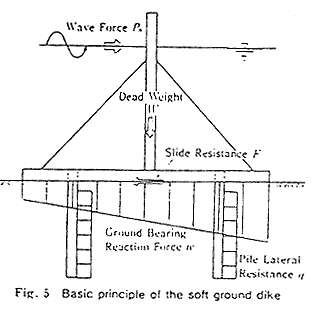
Installation of the conventional gravity type of breakwaters on soft ground as in the case of Kumamoto requires full-scale foundation improvement in advance. If such improvement